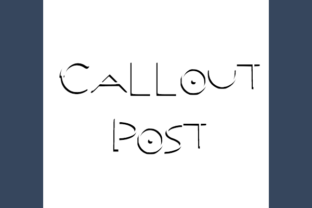
The Art of the Bouncy Decorative Font in Modern Web Design
Typography is often the first handshake a website offers a visitor. It sets a mood, establishes credibility, and guides the eye. But when a project calls for personality, warmth, and a touch of the unexpected, standard serif and sans-serif families can feel a little stiff. This is where the bouncy, decorative font enters the stage. These are typefaces with irregular baselines, exaggerated curves, playful swashes, and a general sense of kinetic energy. They are not meant for body text. They are meant to make a statement. And when they are paired with a tool like Callout Post, the combination can transform a simple message into a memorable visual anchor.
A bouncy decorative font thrives on breaking the grid. The letters might dip below the line, swell in unexpected places, or feature flourishes that resemble hand-drawn ink. This organic quality is exactly what makes them so effective for elements that need to stand out: pull quotes, hero headings, social media graphics, and branded callouts. The keyword here is intentionality. Used correctly, a bouncy font injects joy and approachability. Used carelessly, it can feel chaotic. The trick lies in understanding the font's anatomy, its character support, and the context of the project.
What Makes a Font Feel Bouncy and Decorative
The term "bouncy" is not a formal classification, but designers know it when they see it. These fonts often share a few distinct characteristics. First, they tend to have a variable visual weight. Some strokes are thick and bold, while others are whisper-thin, creating a rhythmic contrast that feels lively. Second, the baseline is rarely static. Some characters might sit slightly higher or lower than their neighbors, mimicking the natural inconsistency of handwriting or vintage sign painting. Third, decorative flourishes are common. Swashes on capital letters, elongated descenders, or playful tails on the letter "y" or "g" add a sense of motion.
Another hallmark is a high degree of personality. A bouncy font might look like it belongs on a vintage carnival poster, a children's book cover, or a trendy café menu. This personality is what makes it decorative rather than utilitarian. When you use a font like this in a Callout Post element, you are signaling to the reader that this piece of text is special. It is a highlight, a takeaway, a moment of emphasis that deserves more than a standard bold weight. The font itself becomes part of the visual rhetoric.
Extended Character Support: More Than Just A to Z
One of the most practical, yet often overlooked, qualities of a good decorative font is extended character support. A bouncy font looks wonderful in English, but what about French, German, Spanish, or even Central European languages? What about punctuation, ligatures, and stylistic alternates? Extended character support means that the font includes a robust set of glyphs: accented letters (like é, ü, ñ, ç), currency symbols, mathematical operators, and often multiple versions of the same letter for stylistic variation.
This matters because a Callout Post might be shared across international audiences, or a brand might need to maintain consistency across multilingual campaigns. Without extended character support, a bouncy font can break under pressure. Accented characters might default to generic fallback fonts, ruining the visual effect. Worse, missing glyphs can cause layout shifts or awkward spacing. Before adopting any decorative font, always check its glyph coverage. Many premium foundries now offer fonts with 200+ characters, including small caps, old-style figures, and multiple ligature sets. This level of support ensures that the font remains usable and visually cohesive, no matter the language or platform.
Where Bouncy Fonts Fit Into Modern Workflows
The role of decorative typography has evolved significantly in the last decade. With the rise of no-code tools, custom CSS, and platforms like WordPress paired with page builders, adding a unique font is easier than ever. But easier does not always mean better. A bouncy font needs a deliberate placement strategy. In a modern workflow, designers often reserve these typefaces for three specific zones: the hero area, the testimonial or quote block, and the call-to-action button or banner.
Consider a typical landing page. The headline might use a clean sans-serif for readability. But a supporting quote from a customer, displayed as a Callout Post, could be set in a bouncy decorative font to give it a human, conversational feel. The contrast between the two typefaces draws the eye and signals a shift in tone. This is not just aesthetic. It is functional psychology. The decorative font tells the brain: "Pay attention, this part is different."
Another common workflow is in email marketing. Email clients have notoriously limited font support, but with image-based callouts or embedded web fonts (supported by most modern clients now), a bouncy font can make a subject line or offer feel more exclusive. Similarly, in social media graphics, where competition for attention is fierce, a decorative font can be the differentiator. A quote card shared on Instagram or LinkedIn that uses a playful typeface will often perform better than one with a standard font, simply because it feels less corporate and more authentic.
Practical Benefits and Real-World Scenarios
Using a bouncy decorative font with extended character support offers several tangible benefits. First, it reduces the need for additional graphic elements. A well-chosen font can carry the visual weight of an entire callout, eliminating the need for heavy borders, icons, or background patterns. This simplifies the design and speeds up page load time. Second, it creates a distinctive brand voice. A brand that consistently uses a unique bouncy font in its callouts and headings becomes instantly recognizable.
Let me give you a concrete scenario. Imagine a lifestyle blog that publishes weekly recipes. The body text is clean and readable, but each recipe card is a Callout Post with a bouncy font for the title. The font includes swashes and alternates, so the word "Ingredients" might have a gently curved "I" and a looping "g" that looks hand-lettered. The extended character support means that when the blog features a French recipe with words like "crème" or "suprême," the accents render perfectly. The result is a cohesive, charming experience that feels crafted rather than templated.
Another scenario might be a small business website for a handmade ceramics studio. The owner wants the homepage to feel warm and tactile. They use a neutral sans-serif for the navigation and descriptions, but the tagline "Made slowly, with intention" appears inside a Callout Post set in a bouncy decorative font. The varied stroke widths mimic the uneven glaze of the pottery. The extended character support ensures that their product names, which sometimes include Japanese or Nordic characters, display correctly. This attention to typographic detail reinforces the brand's artisanal values.
Key Considerations Before Choosing a Bouncy Font
As tempting as it is to jump into the world of playful typography, there are several factors that require careful thought. The first is readability. A bouncy font is inherently less legible than a neutral one. This is acceptable for short phrases, but it can become a barrier if the text is longer than a sentence or two. Always test the font at both small and large sizes. Some decorative fonts that look beautiful at 72pt become muddy or indistinct at 16pt.
Second, consider licensing and embedding. Many high-quality bouncy fonts come from independent foundries and require a paid license for web use. Free alternatives exist, but they often have limited character sets, poor hinting, or missing weights. Investing in a professional font with extended character support is almost always worth it, especially for a branded project. Platforms like Google Fonts offer some playful options, but for true bouncy character with deep glyph support, you may need to look elsewhere.
Third, think about performance. Web fonts add to page weight. A decorative font file with hundreds of glyphs can be larger than a standard one. Use subsetting to include only the characters you need, and consider using the font only for specific elements like a Callout Post rather than loading it across the entire site. This keeps the page fast while still delivering the visual impact where it matters most.
Observations on Pairing and Hierarchy
One of the most common mistakes made with decorative fonts is using them everywhere. A bouncy typeface loses its magic when it competes with itself. The goal is contrast, not uniformity. Pair a bouncy decorative font with a calm, neutral companion. A classic sans-serif like Open Sans, Lato, or Inter works well. The neutral font handles the heavy lifting of body text, labels, and secondary information, while the bouncy font claims the spotlight for the Callout Post or hero heading.
Hierarchy is also critical. If you use a bouncy font for a heading alongside a bouncy font for a callout, you need a clear visual separation. Use size, color, and spacing to differentiate them. The decorative font should never make the user work to parse the message. If a reader has to pause and decipher the letters, the font has failed its primary purpose. Extended character support helps here because it provides alternates and ligatures that can subtly adjust the rhythm of the text without sacrificing clarity.
Recommendations for Integrating with Callout Post
When using a bouncy decorative font inside a Callout Post, there are a few practical steps to ensure success. First, use the font only for the headline or key phrase within the callout, not for the entire block. Keep supporting text in a readable secondary font. Second, leverage CSS properties like font-feature-settings to enable stylistic sets, ligatures, and swashes. This gives you fine control over how the decorative elements appear. Third, always test on multiple devices. A bouncy font that looks charming on a desktop monitor might appear cramped or distorted on a mobile screen.
Another recommendation is to use the font in moderation across the site. You might reserve it exclusively for Callout Post elements, testimonial blocks, or special announcements. This consistency trains the user to associate the decorative typography with highlighted content, making your callouts more effective over time. Extended character support also future-proofs your content. If you later decide to localize your site, you won't need to hunt for a replacement font that matches the aesthetic.
Final Observations on the Bouncy Trend
Bouncy decorative fonts are not a passing fad. They represent a broader shift toward humanized design, where imperfection and warmth are valued over sterile perfection. Brands that embrace this aesthetic signal that they are approachable, creative, and detail-oriented. The key is to use these fonts with purpose. They are not a fallback. They are a deliberate choice that requires consideration of readability, character support, performance, and pairing.
When you find a bouncy font with extended character support that matches your brand's voice, and you place it inside a well-designed Callout Post, you create a moment of delight. That moment can be the difference between a user scrolling past and a user stopping to read. Typography, after all, is the silent ambassador of your brand. Make it bouncy, make it beautiful, and make it inclusive of every character your audience might need.