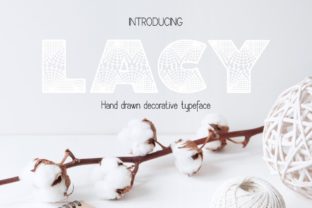
Lacy Decorative Font: Elegance for Every Project
When you first see Lacy, it’s easy to imagine it gracing a wedding invitation or a vintage poster. Created by Hungarian designer Eva Barabasne Olasz, this decorative font draws inspiration from traditional lace patterns—intricate loops, fine strokes, and open spaces that create a sense of airy elegance. But Lacy isn’t merely a pretty face; it’s a tool that different people use in surprisingly different ways. Whether you’re a hobbyist scrapbooker, a freelance graphic designer, or a small business owner trying to build a brand, understanding how Lacy fits into your workflow can save you time and help you achieve the look you want without frustration.
What Makes Lacy Unique
At its core, Lacy is a display typeface meant for headlines, titles, and short decorative text. Its letterforms feature delicate serifs and flourishes that mimic the threads of lace. The lowercase letters tend to be slender and ornate, while the uppercase letters often have more dramatic loops. The overall effect is romantic, feminine, and detailed—qualities that can elevate a design but also require careful use.
The font typically comes in a single regular weight, though some versions include alternate characters or ligatures. Because it is highly decorative, legibility decreases at small sizes or in long paragraphs. It shines when used sparingly, in contexts where its visual texture can be appreciated without competing with readability.
Why Designers and Creators Care About Lacy
Professional and aspiring designers often turn to decorative fonts like Lacy when they need to set a mood quickly. For a wedding stationery suite, a flower shop logo, or a product label for artisanal soaps, Lacy can communicate elegance and craftsmanship in a single word.
For a freelance graphic designer, Lacy becomes a way to differentiate a client’s brand from more generic competitors. Imagine designing a logo for a boutique bakery. Using Lacy for the name on the signage, paired with a clean sans-serif for the tagline, gives the business a distinct, handcrafted feel. The designer’s priority here is quality and flexibility: they need the font to stay crisp at different sizes (from a business card to a storefront window) and to integrate smoothly with design software.
For a hobbyist crafter making digital scrapbooks or custom greeting cards, Lacy is all about ease of use and emotional impact. They may not have formal design training, but they know what looks good. Using Lacy for a “Thank You” card adds instant charm. The hobbyist might pair it with a dotted background or floral clip art. Their evaluation of Lacy focuses on how quickly they can install it (many font marketplaces offer one-click downloads) and whether it comes with free or affordable licensing for personal projects.
Beginner vs. Experienced User
Beginners often worry about legibility. They see a beautiful font and want to use it everywhere—on a poster, in a paragraph, maybe even for body text. With Lacy, that would be a mistake. A beginner’s priority should be learning restraint. The font works beautifully for a short title, but not for a long menu. A practical example: a new blogger trying to design a header for a lifestyle site. Using Lacy for the blog name is fine; using it for the navigation labels will make them hard to read.
Experienced users prioritize reliability and commercial value. They check the font’s licensing (is it free for commercial use? can it be embedded in an eBook or website?). They also test the font’s kerning and spacing. Decorative fonts sometimes have uneven spacing that needs manual adjustment. A professional designer might spend an extra ten minutes tweaking the letter spacing in Lacy to ensure it looks balanced in a logo. They also consider how the font works across different software—Adobe, Canva, Affinity—and whether it includes all special characters (like accented letters) for multilingual projects.
Business Owners and Entrepreneurs
Small business owners often evaluate fonts through a cost vs. return lens. Lacy is not typically a free font; it may be sold through independent foundries or on marketplace platforms for a modest price (often between $10 and $30). For a boutique owner, that cost is trivial if the font helps create branded packaging that attracts customers. They care about presentation and brand consistency. Using Lacy on product tags, website headers, and social media graphics creates a cohesive look that suggests attention to detail.
Consider a candle maker who sells at local markets and online. Using Lacy for the product names (“Vanilla Rose,” “Lavender Dreams”) on labels gives a handmade, luxurious impression. The business owner’s priority is speed—they want a font that looks polished without hiring a designer. Lacy, being a single-weight decorative font, is straightforward to apply. They can upload it to Canva or their label printing software and start creating immediately.
Educators and Students
For an educator teaching graphic design or typography, Lacy serves as a case study in decorative type. The teacher might ask students to analyze the font’s historical inspiration (lacemaking, Victorian era) and discuss when such a font is appropriate. Learning value is the main priority here. Students can practice pairing Lacy with contrasting fonts (a geometric sans like Futura or a slab serif like Rockwell) to understand hierarchy and balance.
A student working on a poster for a school theater production—say, a period drama—could use Lacy for the title and a simple serif for the details. The teacher can point out that Lacy works well for a single word (“Juliet”) but less for a full sentence. This real-world application helps students internalize typographic principles without memorizing rules from a textbook.
Consumers and Event Planners
Everyday consumers who are not professional designers still encounter fonts like Lacy when planning personal events. A bride-to-be crafting DIY wedding programs might search online for “pretty fonts for invitations.” Lacy appears in many roundups. Her priority is creativity and emotional connection. She wants her invitations to feel special, but she also needs the font to be easy to use in a simple word processor or online tool (like Canva). She might not care about commercial licensing or kerning—she just wants to type a name and have it look beautiful.
For such users, Lacy’s ease of use is critical. If the font includes only uppercase and lowercase with no alternate characters, that’s fine for a “Mr. and Mrs.” heading. But if the font requires an expensive license or has limited character support (no punctuation for dates), it becomes frustrating. Many online font sellers clearly label personal use vs. commercial use, which helps non-professionals avoid legal headaches later.
Practical Tips for Using Lacy Effectively
No matter who you are, the key to using Lacy well is understanding its limitations and strengths. Here are actionable guidelines:
- Use it only for short text. One or two words, a single line, or a short phrase. Avoid body text, subheadings, or any paragraph longer than five words.
- Pair with a neutral font. A clean sans-serif (like Open Sans or Montserrat) or a simple serif (like Playfair Display) balances Lacy’s ornate details. Place Lacy on the title and the neutral font on supporting text.
- Test at different sizes. The fine strokes can disappear when printed small. Print a test at your actual size before committing to hundreds of labels.
- Check kerning. In Lacy, the loops and tails may collide or create uneven gaps. Manually adjust letter spacing in software like Adobe Illustrator or use Canva’s spacing controls.
- Respect the mood. Lacy works best for romantic, vintage, feminine, or traditional themes. It can feel mismatched for modern, minimalist, or industrial designs.
Is Lacy Right for You?
To decide, ask yourself a few questions:
- What is the purpose of your project? If you’re creating a birth announcement, a wedding website, a boutique logo, or a decorative poster, Lacy can add the right feel. For a tech startup’s dashboard or a legal document, skip it.
- How much design experience do you have? Beginners who want a quick win can use Lacy in a template. Experienced designers can push it further with custom adjustments. The font itself doesn’t require training, but knowing where to use it does.
- What is your budget? If Lacy costs $20 and you need a single-use font for a personal invitation, that might feel expensive compared to free options. But if you’re using it for commercial branding (stickers, tags, website), the investment pays off.
- Do you need technical flexibility? Lacy typically offers only one weight and limited alternates. If you need multiple weights, italics, or extensive language support, this font may not be sufficient. You might instead look for a decorative family with more breadth.
For many users, Lacy serves as a specialty tool—like a fine needle for embroidery. You don’t use it for every stitch, but when you need it, nothing else creates the same delicate effect. Eva Barabasne Olasz designed Lacy to capture the intricacy of handcrafted lace, and that intention carries through every letter. Whether you are a professional designer balancing speed and quality, a business owner building a brand on a budget, or a hobbyist delighting in beautiful details, Lacy offers specific, measurable value when applied thoughtfully.
Long-Term Usefulness and Commercial Value
One often overlooked aspect of a decorative font is its longevity. Trends in typography shift. A font that feels fresh today might seem dated in three years. Lacy, with its roots in classic lace patterns, has a timeless quality. It does not follow a momentary fashion; it references a centuries-old decorative art form. This gives it a longer shelf life than many trendy handwritten or brush fonts.
For a small business owner, using Lacy on a logo means the brand may not look obsolete quickly. For a creator selling digital products (like SVG quotes or printable art), Lacy’s elegance can appeal to customers looking for sophisticated designs. The font’s commercial value depends on the license—some sellers allow embedding in digital products, while others restrict that. Always read the terms for your specific use case. But as a reliable decorative option, Lacy earns its keep in a designer’s font library.
Some users worry about compatibility. Lacy is available in standard formats (OTF, TTF) and works on both Mac and Windows, as well as in web formats via @font-face if the license permits. That broad accessibility means you can use it across print and digital without technical headaches. The font is also regularly updated by some foundries for newer software, so reliability stays high.
Final Thoughts (Without a Label)
Lacy is not for every project, but when you need delicate flair, it delivers. For beginners, it’s a lesson in restraint and pairing. For professionals, it’s a precise tool that rewards careful handling. For business owners and event planners, it’s a shortcut to elegance that does not require a design degree. By understanding what Lacy offers—and what it does not—you can make an informed choice that saves time, money, and creative energy. Take a minute to download a trial, test it on your own mockup, and see how its lace-like details shift the feel of your work. You might find that this one font becomes your secret weapon for romantic, refined, and memorable designs.