Minnesota Winter: The Blackletter Font That Captures the Season's Stark Beauty
The Visual Language of a Northern Winter
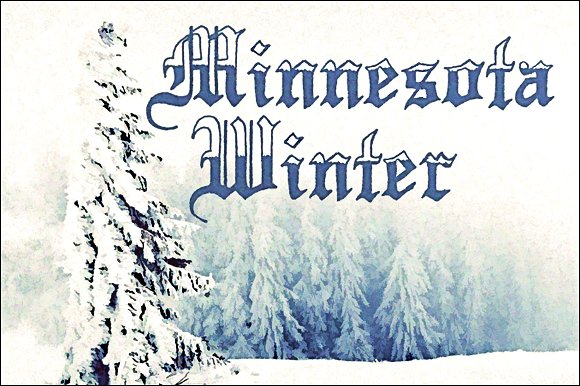
There is something about a Minnesota winter that demands attention. The bare branches against a slate-gray sky, the deep quiet of a snowfall, the angular shadows cast by low afternoon light—this landscape has a stark, graphic quality that translates naturally into typography. Minnesota Winter, a blackletter display font, channels that same raw, gothic sensibility. Its sharp ascenders and heavy, angular strokes evoke the frost and isolation of the season, while its ornamental flourishes recall the decorative ice patterns that form on windows during a deep freeze.
Blackletter faces have long carried associations with tradition, authority, and the handmade. Minnesota Winter takes this heritage and infuses it with a specifically regional character. The font does not try to be neutral or invisible. It is a voice. One that speaks of cold, endurance, and the austere beauty found in the harshest months. For designers, this typeface offers a way to anchor a project in a particular mood without relying on clichéd snowflake motifs or obvious holiday imagery.
Emotional Weight in a Digital Age
As screen-based communication becomes ever more uniform, there is a growing appetite for type that carries emotional weight. Minnesota Winter answers this need. Its gothic structure feels grounded and deliberate, a counterbalance to the endless stream of lightweight sans-serifs that dominate web and mobile interfaces. When a brand or creator chooses this font, they are signaling something about permanence, craft, and a willingness to stand apart from the ephemeral buzz of trending aesthetics.
The Seasonality of Design
Seasonal typography is not new, but its strategic use has matured. Rather than relying on generic "winter" fonts that rely on icy blues and rounded forms, Minnesota Winter offers a sophisticated alternative. It works because it does not shout "holiday." It whispers "season." This distinction matters for businesses and creators who want to evoke winter without limiting themselves to a narrow two-week window of holiday commerce. The font can carry a campaign from late autumn through the deep winter months without feeling stale or over-themed.
Branding and Identity
For breweries, distilleries, and craft food producers based in northern regions, Minnesota Winter provides an authentic visual anchor. A label for a barrel-aged stout or a small-batch maple syrup gains an immediate sense of place and tradition when set in this blackletter face. The font avoids the generic "rustic" tropes that have become ubiquitous in craft branding, offering instead a more restrained and historically informed aesthetic. A coffee roaster specializing in cold-weather blends could use it on packaging alongside a simple descriptive word like "Northeast" or "Frost," letting the typography do the atmospheric work.
Event and Promotional Materials
Winter festivals, outdoor markets, and seasonal theater productions benefit from display type that communicates atmosphere at a glance. Minnesota Winter works exceptionally well on posters, banners, and social media graphics where legibility at large sizes matters. The font's robust x-height and clear internal spacing mean it remains readable even when printed on textured stock or overlaid on photographic backgrounds of snow-covered landscapes. Event organizers can pair it with a clean sans-serif for body copy to create a hierarchy that feels both historic and contemporary.
Publishing and Editorial Design
Literary journals, regional magazines, and book covers that explore themes of isolation, nature, or northern life find a natural partner in Minnesota Winter. A short story collection set in the Upper Midwest, a memoir about surviving a rural winter, or a poetry chapbook examining the relationship between humans and cold environments—all of these can benefit from a cover title that sets the tone before a single word is read. Inside, the font can be used for chapter headings or pull quotes, adding visual punctuation to the reading experience.
Digital Content and Social Media
While display fonts often struggle at small screen sizes, Minnesota Winter retains its character even on mobile devices when used at appropriate sizes. Content creators covering winter sports, cold-weather travel, or seasonal cooking can deploy the font in video thumbnails, story templates, and quote cards to create a cohesive visual identity. The key is restraint: using the font for key words or titles rather than large blocks of text. A single word set in the font—"Frost," "Ember," "Trail"—can anchor an entire visual composition.
Weight and Contrast
The blackletter tradition relies on dramatic contrast between thick and thin strokes. Minnesota Winter executes this with precision. The heavy vertical stems evoke the strength of a frozen trunk, while the fine hairlines and sharp serifs mimic the delicacy of frost. This contrast gives the font a dynamic rhythm when used in short phrases or single words. Designers should be aware that this same quality can make the font less suitable for extended body text, though that is not its intended purpose.
Spacing and Kerning
Display fonts live or die by their spacing. Minnesota Winter includes carefully adjusted kerning pairs that prevent the character overlap common in blackletter faces. This attention to detail means that setting the font in headlines does not require hours of manual adjustment. The default spacing feels open enough to breathe but tight enough to maintain the dense, woven texture that makes blackletter visually compelling.
Character Set and Language Support
Practicality extends beyond aesthetics. The font includes support for common European language characters, making it useful for multilingual projects. For a brand that markets across Canada and the northern United States, this coverage ensures that French-language tags, German product names, or Nordic-inspired branding all maintain consistent visual quality. The inclusion of alternative glyphs or stylistic sets, where available, provides additional flexibility for designers who want to customize the look without distorting the underlying form.
For Business Owners
If you operate a business that trades on heritage, craftsmanship, or regional identity, Minnesota Winter can differentiate your visual presence from competitors who rely on generic typography. A hardware store founded in 1910, a maple syrup producer with a century-old family recipe, or a lodge that has hosted guests since the 1920s—each of these businesses can use the font to signal authenticity in a way that feels earned rather than manufactured. The font works best when applied to logos, signage, and packaging where the audience has time to absorb the detail.
For Creators and Hobbyists
Artists, photographers, and crafters working on winter-themed projects will find the font a versatile tool. A photographer creating a zine of winter landscapes can set the title in Minnesota Winter and let the typography echo the geometric patterns of the images. A woodworker building a line of cutting boards with engraved text can use the font to add a handcrafted quality that matches the physical object. The font's strong visual identity reduces the need for additional graphic elements, which is a distinct advantage for solo creators with limited design resources.
For Educators and Researchers
Typography educators teaching courses on display type, historical letterforms, or regional design trends can use Minnesota Winter as a case study in how a traditional style is adapted for contemporary use. The font illustrates principles of contrast, hierarchy, and mood-setting that are central to graphic design curricula. Researchers studying the resurgence of blackletter in niche branding—from craft breweries to winter sports gear—will find this font a representative example of the trend.
The Real-World Relevance of Themed Typography
The choice to use a font like Minnesota Winter is rarely just about aesthetics. It is a decision that carries practical consequences for brand perception, audience engagement, and project cohesion. When a font encapsulates a specific time, place, or feeling as effectively as this one does, it becomes a shortcut to meaning. Viewers do not need to read a long explanation to understand that a product is rooted in northern tradition, that an event is meant to feel intimate and seasonal, or that a piece of content is about the quiet power of winter.
This efficiency is particularly valuable in environments where attention is scarce. A poster in a busy coffee shop, a thumbnail in a crowded social media feed, a product on a shelf surrounded by competitors—in each case, the font has a fraction of a second to communicate. Minnesota Winter uses its blackletter heritage to command that attention without resorting to visual shouting. The density and history embedded in the letterforms invite closer inspection, which is precisely what effective display typography should do.
Working With the Font in Practice
Successful implementation often depends on pairing. A neutral, minimalist sans-serif such as Helvetica Now or Inter provides a clean counterpoint to the font's ornamentation. For body text, a serif like Lyon or GT America offers enough weight to stand near the display face without competing. Color choices should favor low-saturation palettes—charcoal, slate, cream, deep green—that reinforce the seasonal atmosphere rather than fighting it. A bright neon palette, by contrast, would undermine the font's natural gravitas.
Size and spacing also play critical roles. Minnesota Winter performs best at sizes above 36 points, where the stroke contrast and serif details become visible. At smaller sizes, especially below 24 points, the fine hairlines may begin to disappear depending on the output medium. For print applications, testing on the actual stock is essential, because textured papers will affect how the thinnest strokes register. For digital use, ensuring high-resolution rendering and avoiding compression artifacts preserves the intentional roughness of the letterforms.
Trends and Longevity
The current landscape of typography shows a clear movement toward typefaces that carry cultural and emotional specificity. Generic "safe" fonts are gradually giving way to faces that tell a story, and Minnesota Winter fits squarely within this shift. Its blackletter foundation gives it a timeless quality, while its seasonal name and design cues root it in a particular context. This combination of permanence and specificity is rare, and it gives the font a longer shelf life than trend-driven novelty fonts that rely on gimmicks.
For a creator or business investing in a visual identity, this longevity matters. A font that can be used across multiple seasons—winter after winter—without feeling dated or overexposed offers a better return on investment than one that must be replaced every few years. Minnesota Winter has the structural integrity to become a visual anchor, not a passing experiment. It rewards thoughtful application and reveals new subtleties as designers explore its range across different media.
Bringing the Season Into Your Work
The most effective uses of Minnesota Winter will be those that respect the font's origins while applying it to genuine needs. A local ski resort using it on trail maps and lodge signage feels natural. A podcast about northern ecology using it for episode titles feels intentional. A global brand appropriating it for a superficial winter campaign without any connection to the region or the aesthetic tradition will likely feel dissonant. The font works best when there is a real link—geographic, thematic, or emotional—between the type and the message.
This is not a limitation but a guide. For those who understand the cold, the quiet, and the stark beauty of a winter landscape, the font offers a ready-made visual language. It captures the weight of a snow-laden branch, the sharpness of a frozen breath, and the stillness of a landscape held in winter's grip. Used well, it does not just label content. It becomes part of the experience, inviting viewers to feel the season as much as see it.