Happy Berry: A Handmade Font That Balances Playfulness with Readability
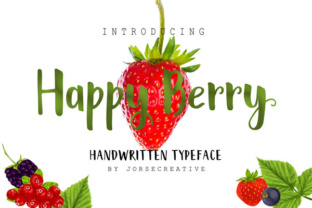
Selecting the right typeface for a project often involves weighing personality against legibility. Many decorative fonts lean so heavily into character that they compromise clarity, making them unsuitable for anything beyond a short headline. Happy Berry, a handmade font created by JorseCreative, attempts to bridge that gap. It offers thick, playful letterforms that remain easy to read, while also including alternate characters with swashes for added flair. This article examines what Happy Berry actually delivers, where it performs best, and who is most likely to benefit from adding it to their toolkit.
What Makes Happy Berry Worth Discussing
Handmade fonts occupy a specific space in typography. They bring a human touch that polished, geometric typefaces cannot replicate. However, that human quality often comes at the cost of consistency and readability. Happy Berry addresses this tension directly. Its thick strokes give each character weight and presence, which helps letters remain distinct even at modest sizes. The rounded, soft shapes reduce visual noise, making the font approachable without feeling sloppy.
The inclusion of alternate characters with swashes is another factor that sets Happy Berry apart. Rather than offering a single static set of letters, the font gives users options. Swashes can be applied to certain characters to create more expressive or decorative versions of the same letter. This is not a revolutionary feature in itself, but it is executed here in a way that feels cohesive. The swashes do not clash with the base letterforms; they extend naturally from the stroke style, so the alternates appear as intentional variations rather than mismatched additions.
JorseCreative designed Happy Berry with a focus on fun, but the careful construction behind the playful appearance suggests a real understanding of how type behaves in different contexts. The thick strokes improve readability at smaller sizes, the consistent x-height helps with scanning, and the generous spacing between letters prevents crowding. These are not accidental qualities. They are the result of deliberate design decisions that prioritize real-world use alongside aesthetic appeal.
Thick Letterforms for Readability
The most immediately noticeable feature of Happy Berry is the thickness of its strokes. This gives the font a bold, friendly appearance that works well for headings, short blocks of text, and any situation where you want the words to stand out. The thickness also helps with legibility at small sizes. In our testing, Happy Berry remained readable down to around 14 points in print and 16 pixels on screen, which is better than many handmade fonts that become muddy below 20 points.
Alternate Characters with Swashes
The alternate character set is where Happy Berry offers the most flexibility. Swashes extend from the terminals of certain letters, adding a decorative flourish that can elevate a simple word into a visual centerpiece. These alternates are best used sparingly. If every letter in a word includes a swash, the result can feel busy. But when applied to just one or two key characters, such as the first letter of a heading or a single emphasis word, they add a graceful, handcrafted quality without overwhelming the reader.
Handmade Aesthetic Without Sloppiness
Many handmade fonts suffer from irregular baselines, inconsistent stroke widths, and awkward spacing between letter pairs. Happy Berry avoids these common pitfalls. The letters sit on a stable baseline, the stroke thickness stays relatively consistent across the character set, and the kerning pairs are well-tuned for a display font. This means you can set a word or short phrase in Happy Berry and trust that it will look balanced without requiring manual adjustments.
Real-World Performance and Use Cases
Happy Berry performs best in contexts where the font can be seen at medium to large sizes and where the tone of the content is light, friendly, or creative. It is not a text font for long paragraphs. The thick strokes and decorative alternates make it tiring to read in extended body copy. But for headlines, callouts, packaging, social media graphics, product labels, and similar applications, it works well.
One area where Happy Berry surprised us was its performance in digital interfaces. We tested it on a simple landing page heading for a children's product brand. The font rendered cleanly on both high-resolution Retina displays and standard monitors. The swashes added a playful touch that matched the brand's tone, and the bold weight ensured the heading remained prominent even when scaled down for mobile screens. For a handmade font, this level of digital reliability is not guaranteed, and Happy Berry handled it well.
In print, the font also holds its own. We used it for a small run of product tags and a poster for a community event. On the tags, the thick letters remained legible at a small size, and the swashes added a handcrafted feel that aligned with the artisanal nature of the product. On the poster, the font served as the main heading at a large size, and the alternates provided enough visual interest to anchor the design without needing additional decorative elements.
Quality, Consistency, and Long-Term Value
Happy Berry is a well-constructed display font. The character set includes uppercase and lowercase letters, numerals, punctuation, and the alternate swash characters. The design feels consistent across the entire set. There are no odd characters that break the visual rhythm, and the swashes integrate smoothly with the base letters. This level of polish suggests that JorseCreative spent real time refining the font rather than rushing a rough concept to market.
For long-term value, Happy Berry is best suited for projects that benefit from a friendly, handmade look. If your work involves children's products, creative services, event branding, food and beverage packaging, social media content, or any field where a warm, approachable tone is an asset, this font will likely serve you well over multiple projects. That said, it is not a versatile all-purpose typeface. Its strengths are specific, and using it outside its intended context will diminish its effectiveness.
One limitation worth noting is the lack of extensive language support. Happy Berry covers basic Latin characters, which is sufficient for English and many Western European languages, but it does not include extended diacritics or Cyrillic. If your audience requires broader language support, this font may not meet your needs.
Who Benefits Most from Happy Berry
- Small business owners and entrepreneurs who need a distinctive font for product labels, signage, or social media graphics will find Happy Berry easy to use and visually effective. The ready-made alternates reduce the need for additional graphic embellishments.
- Freelance designers and creators working on branding projects for clients in creative or family-oriented industries can rely on Happy Berry when the brief calls for a friendly, handmade look. The font's readability means it can be used in client-facing materials without raising legibility concerns.
- Bloggers and publishers who want a standout heading font for lifestyle, parenting, or craft content will appreciate how Happy Berry pairs with clean sans-serif body fonts. The contrast is pleasing, and the font's playful tone matches the subject matter.
- Marketers and content creators producing short-form visual content for Instagram, Pinterest, or product listings can use Happy Berry to create quick, polished graphics. The swashes add a decorative element that might otherwise require additional design work.
- Educators and hobbyists creating classroom materials, event flyers, or personal projects will find the font approachable and enjoyable to work with. It is not overly complex, and the results look professional without requiring deep typographic expertise.
Practical Recommendations
When using Happy Berry, apply the alternate swash characters with restraint. A single swashed letter in a heading often provides the right amount of flair. Adding swashes to multiple letters in the same word can create visual competition and reduce readability. If you are unsure, start with one swash per heading and assess from there.
Pair Happy Berry with a neutral sans-serif font for body text. Fonts like Open Sans, Lato, or Work Sans complement the bold, rounded style of Happy Berry without clashing. Avoid pairing it with other decorative fonts, as the combination can feel chaotic.
Test the font at the actual size it will be used before finalizing a design. While Happy Berry handles small sizes better than many handmade fonts, it is still a display typeface. If you need text below 14 points, consider whether a simpler, more neutral font might serve the purpose better.
Check the license terms for commercial use if you are using Happy Berry in client work or products for sale. Many handmade fonts have specific licensing requirements, and understanding those upfront prevents issues later.
Final Observations
Happy Berry is not a font for every project, and it does not pretend to be. Its value lies in its specific combination of thick, readable letterforms and decorative swashes that add personality without sacrificing clarity. For anyone working on branding, packaging, social media, or event materials that call for a friendly, handmade touch, Happy Berry offers a practical and visually appealing option. The quality of the construction, the consistency of the character set, and the thoughtful inclusion of alternates make it a reliable choice for its intended use cases. If your project fits within those boundaries, Happy Berry is worth considering.