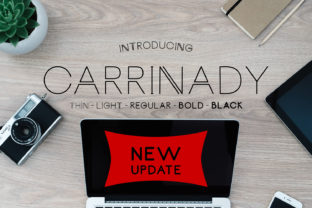
Carrinady: A Modern Sans Serif That Deserves More Than a Quick Glance
Every project carries a silent promise to communicate clearly. The typeface you choose either helps deliver that promise or quietly undermines it. Carrinady, a modern sans serif created by madeDeduk, enters this space with confident simplicity. It works well across both digital and print, making it a versatile candidate for branding, packaging, apparel, and more. But familiarity with font names is not the same as understanding how a typeface performs in real use. Many people select Carrinady for the right reasons but then apply it in ways that reduce its effectiveness. Before you download, buy, or commit to using it, a few practical considerations can save you time, frustration, and disappointment.
What Carrinady Actually Offers and What People Assume
Carrinady is a geometric sans serif with a modern cut. Its letterforms are clean, slightly condensed in some weights, and carry a sense of purposeful restraint. It is not trying to be decorative, expressive, or nostalgic. That honesty is its strength. But here is where many people go wrong: they assume that because a typeface looks simple, it will work everywhere without adjustment. That assumption leads to poor outcomes.
A common misunderstanding is treating Carrinady as a one-size-fits-all solution for branding. Entrepreneurs especially fall into this trap. They see a clean sans serif, think it will look modern and professional, and slot it into every piece of communication from website headers to product labels. While Carrinady can handle multiple roles, forcing it into every context without considering scale, contrast, or spacing often results in a flat, unremarkable presentation.
The better approach is to evaluate what Carrinady does exceptionally well. It excels at medium to large display sizes where its geometric proportions can breathe. For body copy, especially at small sizes on screen, you may need to adjust tracking and line height more aggressively than you would with a typeface designed specifically for extended reading. This is not a flaw of Carrinady. It is a feature of its design intent. Recognizing that lets you use it where it shines and supplement it where it does not.
Overlooking the Details That Affect Usability and Quality
Another mistake that repeats across projects is neglecting to test Carrinady in the actual medium where it will be used. Digital and print look different. A font that appears crisp and balanced on a retina display can feel heavy or lose detail when printed on uncoated stock or vinyl. This is especially relevant for packaging and apparel, where material texture and production method influence legibility.
Consider a small business owner designing product labels for handmade candles. The mockup on screen looks elegant. But once printed on kraft paper, the lighter weights of Carrinady may lose definition because the paper absorbs ink and softens edges. The intended modern look becomes muddy. The fix is simple but often skipped: print physical tests at actual size on the exact material. Adjust weight, spacing, or color contrast before finalizing. If you are working with a screen printer for apparel, request a test pull to see how Carrinady's thinner strokes hold up on fabric.
Another overlooked detail is language support. Carrinady covers a range of Latin-based characters, but if your project requires extended diacritics, Cyrillic, or non-Latin scripts, verify coverage before committing. madeDeduk provides specimen charts. Look at them. Do not assume.
Choosing the Wrong Version or Weight for the Application
Typeface families are not monolithic. Carrinady comes in multiple weights, and each behaves differently in context. A frequent error is selecting a single weight and using it across all applications without variation. This removes the very contrast that makes typography effective.
For example, using Carrinady Regular for both a headline and supporting text creates visual monotony. The headline fails to command attention, and the body text competes for hierarchy. The solution is to use weight variation deliberately. Pair a bolder weight for headlines or key information with a lighter weight for secondary content. This does not require a second typeface. It simply requires you to exploit the range that Carrinady already provides.
Another oversight is not checking how Carrinady behaves when tracked out for all-caps settings. Many modern sans serifs benefit from increased letter spacing in uppercase contexts. Carrinady is no exception. If you set a logo or heading in all caps without adjusting tracking, the letters can feel too tight, especially at larger sizes. A modest increase in letter spacing improves readability and gives the text a more intentional, refined appearance.
Licensing, Download, and Buying Decisions That Cause Headaches
Licensing is one of those details that gets skipped until it becomes a problem. Carrinady is available through various foundries and resellers. Each platform may offer different licensing terms. A desktop license for personal projects does not cover commercial use in branding, packaging, or apparel. The cost of using an unlicensed font in a product launch or marketing campaign can far exceed the price of a proper license.
Before buying, check what the license permits. Does it cover embedding in digital products like apps or ebooks? Does it allow for use in merchandise that you sell? If you are a freelancer or small business owner, you may be tempted to use a trial version or a free download from an unofficial source. This introduces two risks: the font may be incomplete or corrupted, and you have no legal right to use it commercially. Always purchase from a reputable distributor or directly from madeDeduk.
Another point of confusion is the difference between buying a single weight versus the full family. If you only need one weight for a specific project, a single purchase may be sufficient. But if you anticipate needing multiple weights for future work, the family license often costs less per weight and saves you from repurchasing later. Evaluate your needs honestly. Do not buy more than you need, but do not underbuy if your work regularly requires variation.
Mistakes in Pairing Carrinady with Other Typefaces
Combining Carrinady with a second typeface can elevate a design, but only when done with intention. A common error is pairing it with another geometric sans serif that is too similar. The result is confusion rather than contrast. The viewer sees two fonts that feel alike but do not match exactly, which reads as a mistake.
A better approach is to pair Carrinady with a typeface that offers clear contrast in style or proportion. A serif with humanist qualities, a script with organic strokes, or even a monospace for technical contexts can create a deliberate hierarchy. The key is to test the pair in the same document, at the same sizes, and see how they interact. If they compete, try another option. There is no universal perfect pair. There is only what works for your specific project.
Another pairing mistake is using too many typefaces overall. Carrinady can serve as the primary voice of a brand. Adding a secondary typeface for emphasis is fine. Adding a third or fourth often signals indecision. Stick to two, maybe three if the project is complex, and let Carrinady carry the main load.
Practical Checks Before You Commit to Carrinady
Before you finalize Carrinady as your typeface of choice, run through a short checklist. First, test it at the sizes and in the media you will actually use. Second, verify language and character coverage for your content. Third, review the license terms for your specific use case. Fourth, experiment with weight variation and tracking to see how much flexibility the family offers. Fifth, try pairing it with one other typeface and evaluate the result honestly. Sixth, get feedback from someone who is not invested in the project. Fresh eyes catch what familiarity hides.
If you are a blogger or educator creating digital resources, consider how Carrinady performs on different devices and browsers. Test it on mobile, on a lower-resolution screen, and in dark mode. If you are a marketer designing a campaign, test how the typeface reads in a crowded ad layout versus a minimal one. Context changes everything.
A Better Way to Think About Typeface Selection
Choosing a font is not about finding the one perfect typeface. It is about understanding a typeface's strengths and applying them where they matter. Carrinady is a well-made modern sans serif with clear geometry and reliable performance across print and digital. But like any tool, its value depends on the skill and care of the person using it. Mistakes happen when we rush, assume, or skip the testing phase. Corrections are simple once we know what to look for.
Take the time to explore Carrinady's full range before locking it into a project. Read the specimen. Adjust the spacing. Print a sample. Pair it thoughtfully. Licensing aside, the cost of a typeface is small compared to the cost of a design that does not communicate effectively. Investing a little extra attention upfront ensures that Carinady works for you, not against you.