Cabo Slab: A Slab Serif Font That Balances Warmth with Professional Utility
When you are selecting typography for a brand, a publication, or a digital product, the decision frequently comes down to striking the right tone. You need something that feels polished but not cold, expressive but not distracting. Cabo Slab addresses that need directly. As a slab serif font family, it offers the structural presence of serif letterforms while retaining the friendly, rounded qualities inherited from its sans serif counterpart, Cabo Rounded. This combination makes it an exceptionally practical tool for designers who want a typeface that shifts gracefully between print and screen.
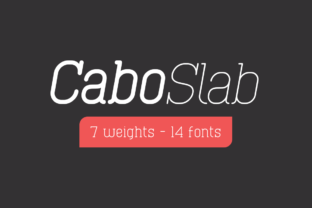
The family includes seven weights and fourteen styles, giving you enough range to build a complete typographic system without patching together multiple unrelated fonts. Whether you are working on a heavyweight brand identity or a light, airy editorial layout, the consistency across the family ensures that your visual language remains cohesive. This is not just a convenience; it directly affects how your audience experiences your content.
When You Need a Typeface That Does More Than One Job
One of the most common frustrations designers face is finding a single typeface family that works well in both headlines and body text. Many slab serifs lean heavily into display use—they look striking at large sizes but become clunky or hard to read in paragraphs. Cabo Slab solves this by offering a range of weights that allow you to scale the same visual language from bold statements to comfortable reading text. The lighter weights retain the slab serif structure but keep the letterforms open and airy, making them suitable for longer passages. Heavier weights bring the presence needed for titles, subheads, and callouts.
This flexibility is especially valuable when you are working on projects that span multiple formats. A brand identity that uses Cabo Slab in its print collateral can carry the same typeface into its website without losing consistency. The font's design, rooted in the friendly geometry of Cabo Rounded, ensures that it renders clearly on screens of all sizes while maintaining the refined detail that makes it stand out in print.
The Practical Value of Seven Weights and Fourteen Styles
Having access to seven weights—from thin to heavy—and fourteen styles including italics means you can build a complete typographic hierarchy without leaving the family. This affects the usability of your design in a direct way. When all your type shares a common DNA, the visual rhythm of your pages becomes more cohesive. Readers subconsciously sense that consistency, and it makes your content feel more polished and intentional.
For example, you might use the Light weight for captions and footnotes, the Regular or Medium weight for body paragraphs, the Bold weight for subheads, and the Heavy weight for main headlines. The italics add another layer: you can set quotes, emphasis, or secondary notes without breaking the visual flow. This kind of structured approach is especially useful in editorial layouts, annual reports, brand guidelines, and long-form digital content where clarity and hierarchy drive reader engagement.
How Cabo Slab Supports Brand Identity Work
Brand identity designers often need a typeface that can stand alone as a logo or wordmark while also functioning across a wide range of applications. Cabo Slab is well suited for this because it balances distinctiveness with neutrality. It has enough character to be memorable—the slab serifs give it a solid, grounded feel—but it is not so idiosyncratic that it becomes difficult to pair with other elements.
The font's roots in Cabo Rounded also give it a subtle softness that makes it approachable. This is a key advantage for brands that want to communicate professionalism without feeling cold or distant. A financial services firm, a lifestyle publication, or a design-forward product company could all use Cabo Slab to signal both competence and warmth. The weight range allows the same brand to use a light, airy version for customer-facing materials and a bolder version for internal communications, all within the same visual system. This reduces the need to license multiple typefaces and simplifies the design workflow.
Choosing the Right Weight for Your Specific Application
Selecting the correct weight within the Cabo Slab family depends on the medium and the message. For print applications such as magazines, brochures, or white papers, the lighter weights work well for body text. They provide readability without overwhelming the page, and the slab serifs add just enough structure to guide the eye along lines of text. The Medium weight is a strong all-around choice for both print and digital body copy, offering a balance between presence and legibility.
For digital interfaces, medium to bold weights often perform best for headlines and navigation elements. Cabo Slab renders clearly at display sizes, and the heavier weights create strong focal points that help users scan content quickly. If you are designing a mobile app or a responsive website, testing the font at various breakpoints is worthwhile. The family's consistent letterforms mean that what works on a desktop screen will translate well to smaller devices, though you may need to adjust weight choices for optimal readability at smaller sizes.
For packaging or environmental design, the heavier weights make a strong impression. They hold up well at large scales and work effectively on products, signage, or exterior displays where the type needs to be legible from a distance. The rounded influence from Cabo Rounded softens the impact slightly, preventing the type from feeling too aggressive or industrial. This makes Cabo Slab a versatile choice for contexts where both visibility and tone matter.
Pairing Cabo Slab with Other Typefaces
Even a versatile family like Cabo Slab sometimes benefits from a complementary typeface for contrast. One of the most natural pairings is with Cabo Rounded itself. Because both families share the same underlying structure, using Cabo Rounded for body text and Cabo Slab for headlines creates a harmonious but distinct hierarchy. This approach works particularly well in digital products where you want a clean reading experience with moments of typographic emphasis.
If you prefer a greater degree of contrast, consider pairing Cabo Slab with a neutral sans serif such as Open Sans or Lato. The slab serif brings warmth and texture, while the sans serif provides a clean counterpart for secondary text, metadata, or UI elements. Alternatively, pairing Cabo Slab with a more expressive serif for display purposes can add editorial richness, though this requires careful attention to ensure the two typefaces share similar proportions and x-heights. Testing pairings at multiple sizes and in realistic layouts will help you avoid surprises during production.
Who Benefits Most from Using Cabo Slab
Different users will find different aspects of Cabo Slab most valuable, depending on the nature of their work. For brand and identity designers, the family's range of weights and its elegant appearance make it a reliable choice for building a cohesive visual language. The fact that it is based on Cabo Rounded means that brands already using that sans serif can extend their typography without introducing a completely new style. This saves time and keeps the brand identity consistent across touchpoints.
For editorial and publication designers, the readability of the lighter weights combined with the impact of the heavier styles offers a practical toolkit for layouts that need to feel both structured and inviting. Magazines, reports, and long-form content benefit from the clear hierarchy that a full-weight family provides. You can maintain reader interest through varied typographic treatments while staying within a single family, which simplifies production and reduces file complexity.
For web and product designers, Cabo Slab brings a level of refinement that is sometimes missing from standard system fonts. It works well for headings, subheadings, and accent text in digital products, and its screen-friendly letterforms reduce the need for extensive adjustments across browsers and devices. Pairing it with a simple sans serif for body copy keeps performance fast while maintaining visual quality. This is especially relevant for content-heavy sites where typography directly influences user trust and reading comfort.
For packaging and environmental designers, the heavier weights offer the presence needed to stand out in three-dimensional contexts, while the friendly curves prevent the type from feeling stark or unwelcoming. In these applications, the font's ability to hold its character at large scales becomes a practical advantage.
Practical Considerations When Implementing Cabo Slab
Like any typeface, Cabo Slab performs best when used with attention to context. For digital projects, ensure that the font files are properly optimized for web use, including appropriate formats such as woff2 for modern browsers. Consider loading only the weights you actually need to keep page load times manageable, though the family's consistency means you can often rely on just two or three weights to cover most needs. This approach keeps performance high without sacrificing design quality.
In print, test the lighter weights at small sizes to confirm that the slab serifs do not close up or become difficult to read. While the font is designed with clarity in mind, every output method introduces subtle variables. Ordering a printed proof or running a digital test at the intended size will help you catch any issues before production. Small adjustments to tracking or leading can make a noticeable difference in final output quality.
When using Cabo Slab in combination with other fonts, pay attention to spacing and line height. Slab serifs often benefit from slightly increased letter spacing in all-caps settings, and generous line height in body text improves readability, especially at smaller sizes. These adjustments are simple to implement but can significantly affect the overall quality of the typography. Taking the time to fine-tune these details will help you get the most out of the family.
A Typeface That Adapts to Your Workflow
What makes Cabo Slab stand out is not any single feature but the way its design choices come together to serve real-world needs. It is a slab serif that does not feel heavy-handed, a family that spans enough weight range to build complete hierarchies, and a typeface that carries the approachable DNA of Cabo Rounded into a more structured form. For designers who need a reliable, elegant, and flexible slab serif, Cabo Slab offers a practical solution that works across print, digital, and brand applications. Whether you are building a new identity system, designing a publication, or refining a digital product, having a family with this level of consistency and character makes the process easier and the results more coherent. The font adapts to your workflow rather than forcing you to adapt to it, which is precisely what a versatile typeface should do.