Strike One: When Typography Becomes a Statement of Purpose
Choosing the right typeface can feel like a high-stakes decision. You might have spent hours scrolling through font libraries, downloading samples, and second-guessing whether that slab serif or geometric sans really captures what you want to say. The challenge is real: most fonts either blend in or shout so loudly that they overwhelm your message. Strike One, a handcrafted font by Creativeqube, steps into that gap with a design that feels both deliberate and approachable. It is not just another display font—it is a tool for creating visual emphasis without sacrificing readability or character.
What Exactly Is Strike One?
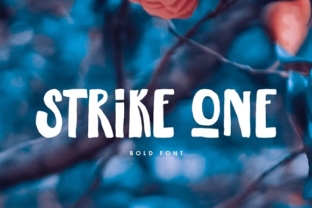
Strike One is a handcrafted typeface developed by the design team at Creativeqube. It carries a bold, confident presence that immediately catches the eye, yet it never feels aggressive or harsh. The letterforms are built with care, showing subtle irregularities that come from manual creation—those slight variations in stroke weight and curve that give a font warmth and personality. This is not a mechanical, uniform typeface. Every character carries the mark of human craftsmanship, which makes it particularly effective for projects where you want to convey authenticity and intention.
At its core, Strike One bridges the gap between custom hand-lettering and a fully usable digital font. You get the uniqueness of something drawn by hand, but with the practicality of kerning pairs, multiple glyphs, and proper file formats that work across software. This matters because many handcrafted fonts require extensive manual adjustment to look right in layouts. Strike One is designed to behave predictably, so you can focus on your message rather than fighting the tool.
The Real Challenge: Finding Fonts That Communicate, Not Just Decorate
One of the most common frustrations for designers, small business owners, and content creators is discovering that a font they love in theory falls apart in practice. Maybe the uppercase letters look fantastic in a logo, but the lowercase becomes unreadable at smaller sizes. Or the font works well for a headline but lacks the versatility to support a full brand identity. These are not minor annoyances—they directly affect how your audience perceives your work.
Another issue surfaces when you need a font that carries weight—literally and figuratively. If you are designing a poster, a product label, or a social media graphic, you need something that commands attention without resorting to tricks like excessive ornamentation or forced stylization. Many bold fonts rely on heavy strokes that make letters feel cramped, especially in words with multiple characters. Strike One avoids this pitfall by balancing its boldness with generous spacing and carefully considered proportions. Each letter has room to breathe, which improves legibility even when the font is used at larger display sizes.
There is also the matter of originality. The market is saturated with fonts that look similar because they are based on the same geometric formulas. If your brand or project needs to stand apart, you cannot rely on something that feels generic. Strike One offers a distinct visual voice. It does not try to mimic every trend. Instead, it leans into its handcrafted roots, giving your text a texture and rhythm that feels fresh and personal.
How Strike One Helps Solve These Typography Problems
When you work with Strike One, the first thing you notice is how effectively it anchors a composition. Because the font carries a strong visual weight, it naturally becomes a focal point. This is ideal for hero headlines, call-to-action buttons, or any element where you need to drive attention. You do not have to add extra effects, outlines, or drop shadows to make the text stand out—the font itself does the work.
The handcrafted quality also solves the problem of coldness that plagues many modern display fonts. Digital typefaces can feel sterile, especially when used at large sizes where every perfect curve is visible. Strike One introduces just enough organic variation to make words feel human. The letters have slight imperfections that recall ink on paper, which creates a sense of tactility even on a screen. This is useful for brands that want to communicate warmth, craftsmanship, or tradition without looking dated.
Another practical benefit is the font's versatility across media. Strike One works well in print applications like posters, packaging, and merchandise, where bold lettering needs to hold up at various distances. At the same time, it translates cleanly to digital contexts—social media headers, website hero sections, video titles, and mobile app interfaces. The legibility remains strong because the letterforms are distinct from one another. There is no confusion between similar characters like capital I and lowercase l, or between O and Q. These may seem like small details, but they make a significant difference when your audience is scanning content quickly.
For anyone who has struggled to maintain brand consistency across different materials and platforms, Strike One provides a reliable anchor. Once you integrate it into your visual system, you can trust that it will perform consistently whether it is printed on a business card, displayed on a monitor, or used in a motion graphic.
Practical Applications and Real Outcomes
The most successful uses of Strike One come from letting it lead rather than compete. In practice, this means using it for primary headlines and letting other typographic elements take a supporting role. For example, a product packaging designer might pair Strike One with a clean, neutral sans-serif for nutritional information and ingredient lists. The contrast creates a clear hierarchy: the brand name or product title grabs attention, while the supporting text remains unobtrusive and readable.
Consider a craft beverage label. The market for artisanal beers, ciders, and spirits is crowded, and shelf appeal is everything. A label that uses Strike One for the brand name immediately communicates that the product is made with care. The handcrafted lettering aligns with consumer expectations for small-batch quality and authenticity. Paired with a restrained color palette and minimal illustration, the typography becomes the primary visual hook. In this context, Strike One does not just label the product—it tells a story about the maker's approach.
Event posters are another area where Strike One shines. Whether it is a music festival, a gallery opening, or a community fundraiser, the font adds a sense of occasion. Its bold presence works well for dates, venue names, and key performer listings. Because the font has a strong character, you can keep the overall poster design simple—maybe a single dominant image and a few lines of text—and still create an impactful layout.
For digital content creators, Strike One can be a secret weapon for video thumbnails and social media graphics. On platforms like YouTube, Instagram, or LinkedIn, the competition for attention is fierce. Thumbnails with clear, bold text significantly outperform those that rely solely on images. Using Strike One for channel names, episode titles, or key takeaways helps your content get noticed in crowded feeds. The handcrafted feel also signals that you put thought into your presentation, which builds trust with viewers.
Small business owners who manage their own branding often face a steep learning curve with typography. Strike One simplifies decisions because it works as a standalone hero typeface. You do not need to master complex pairing systems or understand advanced typographic theory to get good results. A simple layout with Strike One as the headline, a plain sans-serif for body text, and plenty of white space will look professional and intentional. This lowers the barrier to creating polished materials without hiring a designer.
Different Approaches for Different Users
How you work with Strike One depends on your goals and your audience. A graphic designer servicing multiple clients will likely treat Strike One as part of a larger toolkit, pairing it with complementary typefaces and using it selectively for maximum impact. The designer might also experiment with the font's spacing and sizing to create custom lockups that feel unique to each brand. The flexibility of Strike One allows for this kind of exploration without breaking.
A business owner creating packaging or marketing materials might take a simpler approach. The priority here is consistency and speed. Using Strike One as the primary display font across all materials—labels, flyers, website headers, and social media—creates a cohesive visual identity without needing to manage multiple typefaces. This is not lazy design; it is strategic. A single, strong font used consistently builds recognition faster than a scattered mix of styles.
Content creators and influencers often need typography that works across changing contexts. One week you might be launching a product; the next you are promoting an event. Strike One adapts well because it is not tied to a specific aesthetic. It feels contemporary without chasing trends, which means it will not look dated in six months. For creators who cannot afford to redo their branding every season, this longevity is valuable.
Nonprofit organizations and community groups can also benefit from Strike One. These groups often need to produce posters, flyers, and social media campaigns on limited budgets. The font's bold readability means that even simple designs made with basic tools can look impactful. A food drive poster with a Strike One headline and clear call-to-action text will be effective whether it is printed in black and white or in full color.
Implementation Considerations and Recommendations
When you start using Strike One, pay attention to scale. The font is designed to make a statement, so it works best at sizes where the handcrafted details are visible—generally 24 points and above. At smaller sizes, especially in body copy, the organic qualities can become subtle distractions. Reserve Strike One for the moments that matter: titles, headings, pull quotes, and key labels.
Color choices also influence how the font reads. Strike One tends to look its best with solid, saturated colors. Neon or pastel shades can work, but the bold strokes of the font often pair better with deeper hues—navy, forest green, dark red, charcoal—that match its confident tone. For backgrounds, keep things simple. Busy patterns or images behind Strike One text can reduce legibility. If you do place it over a photograph, use a dark overlay or position the text in a high-contrast area.
Pairing Strike One with other fonts requires a light touch. Because the font has such a strong personality, it is best to pair it with typefaces that are neutral and restrained. Clean sans-serifs like Open Sans, Lato, or Inter are reliable companions. Avoid pairing Strike One with another display or handcrafted font—the result tends to feel chaotic. Instead, let Strike One be the voice that speaks first, and let everything else support it.
In terms of software, Strike One works across the major design applications—Adobe Illustrator, Photoshop, InDesign, Affinity Designer, and web-based tools like Canva or Figma. Because it is a well-crafted font with proper hinting and kerning, you will not encounter unexpected spacing issues when moving between programs. This reliability is one of the unsung benefits of a thoughtfully made font.
The Outcome You Can Expect
When you choose Strike One, you are choosing clarity, personality, and reliability. You are choosing a typeface that does not require constant tweaking or elaborate design gymnastics to look good. It stands on its own because it was built with care from the start. Whether you are a designer looking for a new tool, a business owner building a brand, or a creator trying to stand out in a crowded feed, Strike One gives you a foundation that works.
The best outcome is not just a nicer-looking project. It is the confidence that your typography is doing its job—drawing attention, holding interest, and communicating your message without getting in the way. That is the real value of a font like Strike One. It lets you stop worrying about fonts and start focusing on what you actually want to say.