Almaida: A Handwritten Font with a Dancing Baseline for Warm, Personal Typography
Typography choices often settle into reliable patterns. Serif for authority. Sans-serif for clarity. Script for elegance. But sometimes a project calls for something less rigid—something that reads like a handwritten note tucked into a package, not a typeset document. Almaida offers exactly that kind of voice. It is a handwritten font built around a deliberately uneven baseline, giving every word a gentle, lived-in rhythm. This is not a font designed to disappear into the background. It is meant to be felt.
Almaida belongs to a growing category of typefaces that prioritize human warmth without sacrificing professional polish. Its dancing baseline, contextual alternates, standard ligatures, stylistic alternates, and stylistic sets give designers and content creators genuine flexibility. But warmth alone does not make a font useful. What matters is whether Almaida can hold up under real working conditions—across devices, media, and reading contexts. This article evaluates Almaida from that practical standpoint, helping you decide if it fits your projects, audience, and workflow.
What Makes Almaida Worth Discussing
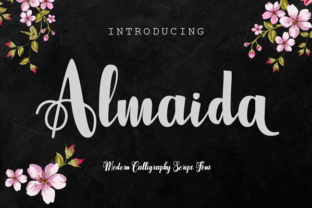
Many handwritten fonts lean heavily on a single stylistic trick: a rough edge, an exaggerated slant, or a quirky glyph shape. Almaida takes a different approach. Its defining feature is the dancing baseline—a subtle vertical oscillation that makes each line of text feel hand-drawn rather than mechanically aligned. This alone sets it apart from most script and handwritten offerings, which typically default to a flat baseline even when the letterforms themselves are informal.
The dancing baseline is not random. It follows a controlled pattern that preserves readability while introducing the natural unevenness you would see in handwriting from a pen or brush. For readers, this creates an unconscious sense of personal correspondence. The text feels addressed to them, not broadcast to a crowd. For professionals who need to communicate trust, approachability, or authenticity, that perceptual shift carries real weight.
Beyond the baseline, Almaida includes a substantial set of OpenType features. Contextual alternates automatically adjust letter shapes based on surrounding characters, preventing awkward collisions or repetitive forms. Standard ligatures handle common letter pairings smoothly. Stylistic alternates and stylistic sets give you manual control over the font’s personality, letting you dial the informality up or down depending on context. These are not decorative extras. They are functional tools that affect how the font behaves in paragraphs, headlines, and short-form text.
Key Characteristics and Typographic Features
To understand Almaida’s practical value, it helps to break down exactly what it offers and how those features translate into real use.
Dancing Baseline
The most immediately noticeable characteristic. Letters sit at slightly varying heights, creating a wave-like flow across the line. This effect is most pronounced in longer passages, where the cumulative rhythm gives the text a storytelling quality. In short bursts—headlines, callouts, signatures—it adds a tactile, handcrafted feel without crossing into illegibility.
Contextual Alternates
These are automatic substitutions that occur based on letter position and neighboring glyphs. For example, a lowercase "a" at the beginning of a word may take a different form than the same letter in the middle. This reduces visual repetition and makes the text look more natural, as if written by hand rather than assembled from repeating units. In practice, this feature is most valuable for longer blocks of text, where repeated glyph shapes can become distracting in less sophisticated fonts.
Standard Ligatures
Common letter pairs like "fi," "fl," "ff," and "tt" are handled with custom joins that smooth out the transition between characters. These ligatures are standard in quality typefaces, but in Almaida they are designed to harmonize with the dancing baseline, so the joins do not look forced or disconnected from the overall rhythm.
Stylistic Alternates and Stylistic Sets
These give you direct control. Stylistic alternates offer alternative versions of specific letters—usually more flourished or simplified variants. Stylistic sets bundle multiple alternates into cohesive groups, letting you switch the font’s overall character with a single toggle. For instance, one set might introduce more looped descenders, while another tightens the letter spacing for denser layouts. This is where Almaida shows its flexibility, adapting to both formal and casual contexts without requiring a separate font file.
Real-World Performance and Practical Value
Typography lives in the real world, not in specimen sheets. How does Almaida perform when embedded in a website, printed on a brochure, or rendered on a mobile screen?
In web use, Almaida handles well at moderate to large sizes. The dancing baseline is most effective above 18–20 pixels, where the vertical variation remains visible and intentional. At smaller sizes, the effect can feel subtle or, depending on the rendering engine, slightly uneven. If you plan to use Almaida for body text on a screen, test it at your target size across browsers. For headings, pull quotes, hero text, and display applications, the font shines. The warmth comes through clearly, and the contextual alternates prevent the mechanical repetition that often undermines handwritten fonts in digital environments.
In print, Almaida performs consistently. The baseline movement translates well to ink, and the ligatures hold up at typical print resolutions. For stationery, greeting cards, packaging, and small-run printed materials, it delivers a premium handcrafted look without the cost or inconsistency of actual hand lettering. For larger print runs, the font’s OpenType features ensure uniformity across all copies while still preserving the organic feel.
One area where Almaida proves especially effective is in short-form, high-impact contexts. Think product labels, quote cards, social media graphics, email headers, and personalized communications. In these settings, the font’s personality is immediately apparent, and the dancing baseline adds a layer of emotional resonance that flat scripts cannot match. Readers often respond to Almaida-set text with comments like "this looks handwritten" or "it feels personal." That reaction is exactly what the font is designed to achieve.
Quality, Usability, and Flexibility
From a technical standpoint, Almaida is well-constructed. The glyph set is comprehensive, covering standard Latin characters, numerals, punctuation, and common diacritics. The OpenType features are implemented cleanly, with no unexpected behavior across major design software—Adobe Illustrator, InDesign, Photoshop, Figma, and Affinity products all handle the contextual and stylistic features without issue. Web font implementation via @font-face is straightforward, and the file sizes are reasonable for both desktop and web use.
Usability is where Almaida earns its keep. The font includes enough stylistic variation to serve multiple roles within a single project. You can use the default setting for body text, activate a stylistic set for headlines, and apply alternates for emphasis—all from one typeface. This reduces the need to switch between different fonts for different purposes, which simplifies workflow and ensures visual consistency.
Flexibility, however, comes with a caveat. Almaida is not a neutral font. Its personality is pronounced, and it will dominate any layout it is placed in. If your project requires a typeface that stays out of the way, Almaida is not the right choice. It demands attention and expects to be part of the design conversation. That is a strength for certain projects and a limitation for others.
Who Benefits Most from Almaida
Almaida is not a universal workhorse font, but for specific audiences and use cases, it is remarkably effective.
Small business owners and entrepreneurs who rely on personal branding will find Almaida useful for packaging, thank-you cards, website headers, and social media content. The font communicates care and individuality without requiring a designer’s budget.
Freelancers and creators in fields like wedding photography, calligraphy-adjacent design, stationery, and lifestyle content can use Almaida to reinforce a handmade, approachable brand voice. It also works well for email newsletters and personal websites where a friendly tone is central.
Bloggers and publishers who write in niches like home decor, journaling, parenting, or creative entrepreneurship can use Almaida for pull quotes, section headings, and featured text. It adds visual interest without undermining readability.
Educators and course creators may find Almaida effective for presentation slides, handouts, and workbook titles. The warmth of the font can make learning materials feel less formal and more engaging, especially for audiences who respond to a relational teaching style.
Marketers working on campaigns that emphasize authenticity, storytelling, or personal connection can leverage Almaida in email subject lines, landing page headers, and print collateral. It pairs well with clean sans-serif fonts for body text, creating a contrast that is both readable and emotionally resonant.
Professionals who send physical correspondence—thank-you notes, holiday cards, client gifts—can use Almaida to elevate printed materials without resorting to generic script fonts. The dancing baseline ensures each piece feels unique, even when using a template.
Situations Where Almaida Excels
Almaida performs best when the goal is to reduce distance between the sender and the receiver. An email header set in Almaida reads differently from one set in Helvetica. A product label in Almaida suggests care. A handwritten quote in Almaida feels like a personal motto, not a stock image.
Specific project types where Almaida delivers strong results include:
- Branding for boutique businesses, artisans, and personal brands
- Packaging and product labels for handmade or small-batch goods
- Wedding invitations, save-the-dates, and event stationery
- Social media graphics that rely on quote overlays or announcement text
- Email newsletter headers and callout sections
- Print materials like greeting cards, postcards, and note cards
- Websites where the hero section needs a warm, welcoming tone
- Presentation decks for creative pitches or storytelling-heavy content
- Book covers, especially for memoirs, self-help, or lifestyle genres
- Digital products like planners, journals, and workbook templates
In all of these contexts, Almaida contributes a layer of emotional texture that many fonts cannot achieve. The key is using it deliberately, not as a default.
Possible Limitations to Consider
No font is perfect for every job, and Almaida has boundaries worth acknowledging.
The dancing baseline, while charming, reduces legibility in long blocks of small text. If you need to set more than a few paragraphs below 14 points, Almaida may tire the reader’s eye. Reserve it for display sizes or short passages unless you are working in a print medium with high resolution and generous leading.
The font’s personality can conflict with minimalist or highly structured layouts. If your design relies on strict grids, clean lines, and reserved typography, Almaida may feel intrusive. It pairs best with layouts that have breathing room and a handcrafted or organic sensibility.
Some users may find the stylistic alternates and sets require a learning curve. While the default behavior is solid, getting the most out of Almaida means understanding how to activate and combine its OpenType features. Designers unfamiliar with stylistic sets may need to experiment before finding the right configuration for their project.
Finally, Almaida is not a substitute for actual handwriting in situations where authenticity is paramount. For a personal letter or a one-of-a-kind invitation, nothing beats a real pen. Almaida is a tool for scale and consistency, not a replacement for genuine handcraft.
Practical Recommendations for Using Almaida
If you decide to add Almaida to your toolkit, a few practices will help you get the most from it.
Pair Almaida with a neutral sans-serif or serif for body text. A font like Open Sans, Lato, or Source Serif provides a stable counterpoint to the dancing baseline. Use Almaida for headings, subheadings, and emphasis. This contrast gives the layout structure while letting Almaida’s personality shine where it matters most.
Test Almaida at your target sizes early in the design process. What looks charming on a specimen sheet may read unevenly at small sizes on a backlit screen. Render it in context, adjust leading and tracking, and evaluate how the baseline movement interacts with your layout grid.
Explore the stylistic sets before committing to a final look. Almaida includes multiple personalities under one name. A set with tighter spacing and simpler alternates may work better for a professional brochure, while a looped, flourished set may suit a wedding invitation. The same font can serve both roles if you take the time to configure it.
Consider using Almaida in digital-first projects that will be viewed on retina or high-resolution displays. The font’s subtleties—the alternates, the ligatures, the baseline rhythm—become more apparent at higher pixel densities. On lower-resolution screens, some of that nuance may be lost.
Almaida occupies a specific but valuable space in the typography landscape. It is not a font for every project, but for the right project it delivers something many typefaces cannot: a sense that a human being wrote those words. In a media environment saturated with polished, impersonal communication, that small difference matters. Whether you are branding a boutique business, designing a wedding suite, or building a personal website, Almaida offers a warm, flexible, and professionally crafted tool for making your text feel less like a document and more like a note. Use it with intention, pair it thoughtfully, and let the dancing baseline do what it does best—remind readers that there is someone on the other side of the words.