Revolution Brush: A Handmade Font for Designers Seeking Delicate Character
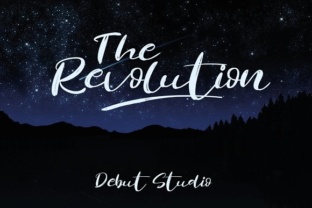
When selecting a typeface for a project, the choice often comes down to balancing personality with readability. Among the many options available, Revolution Brush stands out as a distinctly handmade font, created with a fine brush pen to achieve a delicate, organic look. This article offers a balanced evaluation of Revolution Brush, exploring its strengths, limitations, and practical fit for various design contexts. It aims to help you decide whether this font aligns with your specific project needs.
What Is Revolution Brush?
Revolution Brush is a decorative typeface characterized by its hand-painted origin. Unlike fonts generated from precise geometric vectors, Revolution Brush was physically drawn with a fine brush pen, which gives each character subtle variations in stroke weight, angle, and texture. The result is a font that retains the warmth and irregularity of handwritten lettering while offering the convenience of a digital typeface. It is available as a standard font file, making it usable in most design software, from Adobe Creative Suite to web design platforms.
The font’s delicate lines and gentle curves distinguish it from bolder, more aggressive brush scripts. It does not attempt to mimic the heavy ink bleed of a marker or the rigid consistency of a calligraphy nib. Instead, Revolution Brush captures the light touch of a fine brush, resulting in a soft, airy appearance that works well in spaces where subtlety is valued.
Why Consider Revolution Brush?
Interest in Revolution Brush typically arises from a desire to infuse a design with human character without resorting to loud or overly decorative options. Below are several reasons why designers, hobbyists, and business owners might evaluate this font:
- Unique aesthetic: Revolution Brush offers a look that is difficult to achieve with standard script or brush fonts. Its handmade quality adds a layer of authenticity and craftsmanship that many modern designs seek.
- Versatility in scale: Because of its fine, delicate strokes, Revolution Brush can be used effectively at both small and large sizes, though its best performance is often seen in medium to large headings or display text.
- Appeal for specific industries: Brands in the creative arts, boutique retail, wedding planning, organic food, and lifestyle blogging frequently benefit from the gentle, personal touch that Revolution Brush provides.
- Compatibility with minimal layouts: The font pairs well with clean, minimalist designs where it can serve as a focal point without competing with other elements.
Distinctive Handmade Quality
The primary benefit of Revolution Brush is its handmade origin. In a landscape where many fonts are algorithmically generated, this typeface retains the subtle imperfections of a real brush pen. Slight variations in stroke thickness and character width give text a natural rhythm that feels human rather than mechanical. This can be especially valuable for projects where authenticity is a core brand value.
Light and Airy Visual Weight
Revolution Brush does not overwhelm a page. Its fine lines allow it to sit gracefully on top of backgrounds, images, or colored fields without dominating the composition. This makes it a strong candidate for overlays, watermarked text, or delicate headings that should complement rather than compete.
Good for Both Digital and Print
The font is designed to function across media. In digital applications, it renders clearly on screens at appropriate sizes, retaining its brush-like texture. In print, the fine strokes translate well onto paper, especially when used with high-quality printing methods. It has been tested on apparel as well, making it suitable for T-shirt designs, tote bags, and other merchandise where a hand-lettered feel is desired.
Tradeoffs and Considerations
While Revolution Brush offers a distinctive look, it is not without limitations. Understanding these tradeoffs is essential for making an informed choice.
Readability at Small Sizes
Because the strokes are fine and delicate, Revolution Brush can become difficult to read when used at very small sizes, such as body text or footnotes. The subtlety that makes it beautiful in larger formats can become a liability in dense, small-scale applications. For projects that require extensive legibility in paragraph text, this font may not be the best choice.
Limited Character Set and Language Support
Handmade fonts often come with a more limited character set compared to professionally engineered typefaces. Revolution Brush may lack certain diacritical marks, ligatures, or extended language support. Before committing to this font for a multilingual project or one requiring special characters, verify that the specific language requirements are covered.
Potential for Overuse
The handmade, delicate style of Revolution Brush is distinctive, but that distinctiveness can also lead to visual fatigue if used too broadly across a brand or project. It works best as an accent font for headings, quotes, or logos rather than as a primary text font. Using it for every element can dilute its impact and make a design feel monotonous.
Licensing and Cost
As with many specialty fonts, Revolution Brush may require a purchase or licensing fee for commercial use. While free versions might be available for personal projects, commercial applications typically require a license. Be sure to review the licensing terms carefully to avoid legal issues.
Where Revolution Brush Shines
Based on its characteristics, Revolution Brush is a strong fit in several specific scenarios:
- Wedding and event invitations: The delicate, romantic quality of the font aligns well with formal or semi-formal event materials.
- Creative portfolio headers: Artists, photographers, and designers can use Revolution Brush to introduce sections of their portfolio with a personal touch.
- Product packaging for artisanal goods: Handmade soaps, candles, small-batch foods, and craft items benefit from the font's authentic feel.
- Social media graphics: In quote cards, announcement posts, or brand stories, Revolution Brush adds a refined, human element that stands out in crowded feeds.
- Apparel and merchandise: The font works well on T-shirts, hoodies, and accessories where a hand-lettered aesthetic is popular.
When Alternatives Might Be Better
There are situations where Revolution Brush may not be the ideal choice, and other fonts might serve the project better:
High-Legibility Requirements
For projects where text must be read quickly and accurately—such as mobile app interfaces, signage, or body copy—a more legible sans-serif or serif font would outperform Revolution Brush. Consider fonts like Open Sans, Lato, or Merriweather for such contexts.
Bold or Industrial Branding
Brands that aim for a strong, bold, or industrial image may find Revolution Brush too delicate. In these cases, heavier brush fonts, slab serifs, or geometric sans-serifs might align better with the brand personality.
Large-Scale Text Blocks
If the design requires extensive paragraphs or dense information, Revolution Brush is not recommended. Its fine strokes and variable weight make it tiring to read in long passages. A more neutral, readable font should be used for body text, with Revolution Brush reserved for display purposes.
Budget Constraints for Commercial Use
If the project has a very limited budget, the cost of licensing Revolution Brush might be a barrier. In that case, exploring free or open-source handwritten fonts, such as Satisfy or Pacifico, could provide a similar aesthetic without the expense.
Practical Decision-Making Insights
To determine whether Revolution Brush aligns with your goals, consider the following practical steps:
- Define the role of the font in your project. Is it for headings, body text, or accent use? Revolution Brush works best as a display or accent font. If you need a workhorse text font, look elsewhere.
- Test the font at the intended size. Download a trial version or use a preview tool to see how Revolution Brush renders at the actual size you plan to use. Pay attention to readability and whether the delicate strokes hold up.
- Evaluate your audience. Will the people viewing your design appreciate a handmade, delicate aesthetic? If your audience expects clean, modern, or highly professional styling, Revolution Brush may not suit their expectations.
- Pair it carefully. Revolution Brush pairs well with simple, neutral fonts that do not compete for attention. A clean sans-serif like Helvetica or Roboto can complement it well. Avoid pairing it with other decorative fonts.
- Review licensing. Confirm the licensing terms for your specific use case. If the font is for a client project or commercial product, ensure you have the appropriate rights.
Is Revolution Brush Right for You?
Revolution Brush is a specialized tool in the typographer's kit. It is not a universal solution, nor should it be treated as one. Its strength lies in its ability to add a gentle, authentic, and human touch to designs that call for subtle personality. If your project needs a font that feels handcrafted without being loud, and if the context allows for a delicate visual weight, then Revolution Brush is worth serious consideration.
However, if your priorities are maximum legibility, broad language support, or a bold presence, you may find that other fonts serve you better. The key is to use Revolution Brush intentionally, in the right role, and with an understanding of its limitations. By doing so, you can leverage its unique qualities to elevate your design without compromising on functionality.
Ultimately, the decision comes down to the specific needs of your project and the message you want to convey. Revolution Brush offers something genuinely different in a crowded font market, but like any design tool, it is most effective when used with clarity of purpose.