Knick Knack: A Practical Look at Darrell Flood’s Whacky Display Font for Comic and Cartoon Work
Font selection often determines whether a design lands or falls flat. When the project calls for personality, movement, and a touch of irreverence, standard typefaces rarely suffice. Knick Knack, created by type designer Darrell Flood, steps into this gap with a deliberate departure from convention. Described as a whacky, dynamic, old-style font built for cartoon and comic work, it offers more than mere novelty. Understanding what this font delivers, where it excels, and where it may fall short helps designers, marketers, and content creators decide if it belongs in their toolkit.
What Is Knick Knack? Origins and Design Philosophy
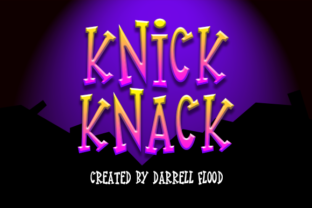
Knick Knack belongs to the category of display typefaces designed for impact rather than extended reading. Darrell Flood designed it with an explicit purpose: to evoke the hand-lettered energy found in classic comic strips, editorial cartoons, and playful packaging. The font draws from the visual language of mid-century cartooning, where letters bent, stretched, and wobbled to match the mood of the scene. Unlike refined text fonts that prioritize uniformity, Knick Knack embraces irregularity as a feature. Each character carries a hand-drawn quality, with uneven stroke weights, tilted baselines, and unexpected curves that mimic the spontaneity of ink on paper.
The “old style” descriptor in its marketing refers not to traditional serif proportions but to a vintage cartoon aesthetic rooted in the early to mid-1900s. This era valued expressive lettering over mechanical precision. Flood’s interpretation updates that approach for digital use while preserving the raw, unpolished charm that makes hand-drawn type so effective in certain contexts. The result is a font that looks like someone sketched it with a brush pen or marker, complete with the small imperfections that give lettering a human touch.
Key Characteristics of Knick Knack
Several defining traits set Knick Knack apart from more conventional display fonts. Understanding these characteristics helps users evaluate whether the typeface aligns with their project goals.
Irregular Stroke Weight and Texture
Knick Knack avoids the even, consistent line quality typical of digital fonts. Strokes thicken and thin naturally, simulating the pressure variation of a handheld tool. This texture adds warmth and authenticity to designs that need to feel handcrafted rather than mechanically produced. For projects aiming to convey spontaneity or a personal touch, this trait proves valuable.
Dynamic Letterforms and Varied Baselines
Characters in Knick Knack do not sit on a rigid baseline. Some letters rise above, others dip below, creating a bouncing rhythm across the page. This intentional unevenness mimics the energy of hand-lettered comic speech balloons and action words. When applied to headlines or short phrases, the effect is lively and engaging, drawing the reader’s eye along the text.
Whacky Proportions and Stylized Details
Certain letters in the font feature exaggerated shapes—wide bowls, elongated ascenders, or compressed descenders. These distortions serve a functional purpose in cartoon contexts, where visual emphasis often matters more than legibility in the traditional sense. The font also includes alternate glyphs and stylistic variants in some versions, giving users control over how quirky or restrained the final text appears.
Limited Character Set but Purpose-Driven
Like many specialty display fonts, Knick Knack focuses on the essential character set needed for headlines and short text. Users should not expect extensive multilingual support or a full range of symbols. The font works best for English-language projects and may lack accented characters required for other languages. This limitation is common among niche typefaces and matters most when the intended audience includes non-English readers.
Strengths and Practical Value in Real-World Use
Knick Knack shines in specific scenarios where conventional typography feels too rigid. Evaluating its strengths honestly helps determine whether the font solves a genuine problem or merely adds decoration.
Comic Lettering and Speech Balloons
The most obvious application is comic and cartoon work. Lettering dialogue, sound effects, and captions requires a typeface that matches the visual language of the artwork. Knick Knack delivers the expressive, slightly messy quality that professional comic artists often achieve through hand lettering. For independent comic creators who lack the time or skill to hand-letter every page, this font offers a credible shortcut. It maintains the organic feel needed to avoid the sterile look of standard fonts in a graphic novel panel.
Editorial Cartoons and Satirical Content
Editorial cartoonists and satirical publications need typefaces that visually reinforce the tone of the content. A serious serif font undermines a humorous or biting cartoon. Knick Knack’s whacky appearance signals to the reader that the content is informal, exaggerated, or tongue-in-cheek. This alignment between visual and verbal tone strengthens the overall message.
Packaging and Product Branding for Playful Markets
Certain consumer products benefit from packaging that looks handmade or vintage. Specialty foods, craft beverages, toys, and novelty items often use quirky typography to stand out on shelves. Knick Knack fits this niche when the brand identity calls for nostalgia, humor, or a sense of fun. However, it is not suitable for premium or luxury positioning, where refined typography communicates quality and sophistication.
Social Media Graphics and Short-Form Content
Marketers and content creators working on social media posts, YouTube thumbnails, or digital banners can use Knick Knack to grab attention in crowded feeds. The font’s dynamic shapes work well for short phrases, calls to action, or titles that need to convey energy. For longer body text, however, the font quickly becomes fatiguing to read, so its use should remain confined to headlines and emphasized words.
Quality, Usability, and Technical Considerations
Assessing a font’s quality extends beyond visual appeal. File integrity, kerning, spacing, and compatibility with design software affect the user experience. Knick Knack performs adequately in these areas with some caveats worth noting.
Kerning and Spacing Behavior
Because Knick Knack mimics hand lettering, its spacing is intentionally loose and uneven. This works well for display use at larger sizes but can create problems at smaller sizes or in tightly packed layouts. Users should preview the font at the intended output size before committing to a design. In professional layout software like Adobe Illustrator or Affinity Designer, manual kerning adjustments may be necessary to achieve the desired rhythm.
File Formats and Licensing
Knick Knack is typically available in standard formats such as OTF and TTF, ensuring compatibility with most design applications. Users should verify the licensing terms for commercial use, especially for projects involving product packaging, merchandise, or digital products sold to customers. Some versions of the font may restrict embedding in apps or web use. Consulting the license agreement before purchase or download prevents legal issues later.
Installation and System Performance
Installation follows the standard procedure for any operating system and presents no unusual challenges. Once installed, the font renders reliably across major design applications. No reports of rendering errors or missing glyphs exist in common usage scenarios. The font’s file size remains modest, and it does not affect application performance.
Who Benefits Most from Knick Knack?
Not every designer or project needs a whacky display font. Identifying the users and contexts where Knick Knack delivers genuine value helps avoid inappropriate applications.
- Comic artists and graphic novelists looking for a consistent but organic lettering style across multiple pages will find the font saves time while preserving a hand-lettered aesthetic.
- Editorial cartoonists and satirists who need typography that matches the irreverent tone of their work can rely on Knick Knack to reinforce visual humor.
- Small business owners and indie product creators marketing novelty items, craft goods, or nostalgic products can use the font to create distinctive packaging without hiring a hand-lettering specialist.
- Social media managers and content creators producing short, visually driven posts benefit from the font’s ability to grab attention in fast-scrolling environments.
- Educators and workshop leaders teaching design or cartooning may use Knick Knack as an example of how typeface choice affects tone and audience perception.
Those Who May Want to Look Elsewhere
Professionals working on corporate branding, formal publications, long-form editorial content, or any project requiring refined, neutral typography should avoid Knick Knack. Its personality is too strong for contexts where the typeface should remain invisible to the reader. Additionally, designers seeking multilingual support or extensive glyph sets will need to supplement this font with others or choose a more comprehensive alternative.
Limitations and Realistic Trade-Offs
No font solves every problem. Acknowledging Knick Knack’s limitations helps users make informed decisions and avoid frustration during production.
The font’s legibility decreases significantly at small sizes. For body text, footnotes, or any passage longer than a few words, readers may struggle to parse the characters. This limits its utility to display roles exclusively. Designers working on projects that mix headlines with descriptive copy should pair Knick Knack with a clean, readable secondary font such as a simple sans-serif or a neutral slab serif.
The whacky nature of the letterforms can also feel repetitive across extended use. A full page of dialogue set in Knick Knack tires the eye faster than more restrained lettering. For comic projects involving extensive captioning or narration, alternating between Knick Knack for emphasis and a simpler font for longer passages improves readability without sacrificing personality.
Because the font deliberately rejects uniformity, users accustomed to precise typographic control may find the unpredictability frustrating. Aligning text along a strict grid or achieving symmetrical layouts becomes difficult. The font rewards designers who embrace its quirks and penalizes those who try to force it into rigid structures.
Long-Term Value and Versatility
Knick Knack occupies a specific niche within the landscape of display typefaces. Its long-term value depends on the frequency with which a user encounters projects suited to its style. For comic artists and illustrators who produce work regularly, the font becomes a reliable tool that justifies its cost through repeated use. For generalist designers who only occasionally need a whacky cartoon font, the investment may be harder to justify, especially if a free alternative exists with similar characteristics.
The font’s durability also depends on trends. Whacky, hand-drawn typefaces cycle in and out of fashion. While Knick Knack draws on a classic cartoon tradition that has persisted for decades, its use in branding and marketing may feel dated if applied indiscriminately. Designers should evaluate whether a project benefits from a vintage cartoon aesthetic or merely follows a current fashion.
Darrell Flood’s design demonstrates a clear understanding of the cartoon lettering tradition. The font does not try to be everything to everyone, which is ultimately its strength. For the right user and the right project, Knick Knack delivers exactly what it promises: a whacky, dynamic, old-style typeface that brings energy and personality to comic and cartoon work.
Choosing Knick Knack means accepting its limitations and leveraging its distinctive voice. When used intentionally and paired with complementary typefaces, it becomes a functional asset rather than a novelty. For creators who value expressive typography and work in contexts where a playful tone is appropriate, the font earns a place in the library.