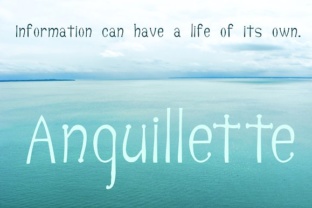
Anguillette: An Art Nouveau Revival for the Green Economy
Every conversation about the future seems to circle back to going green. The phrase has become a shorthand for a new economy—one built on sustainability, organic systems, and a return to natural rhythms. Yet for all the talk, few can describe what that world will actually look like. The visual language of that future remains undefined.
It is worth remembering that this is not the first time designers have looked to the environment for direction. The Art Nouveau movement, at the turn of the last century, drew heavily from organic forms—curving vines, flowing water, and the irregular shapes found in nature. Anguillette is a typeface that revives that spirit. It is a font built on the same principle: that organic expression can be both beautiful and functional. Designed with an eye toward the natural world, it aims to bring a flowing, authentic lilt to your typography.
What Anguillette Is and Why It Deserves Attention
Anguillette is not another geometric sans-serif or generic slab. It is a carefully crafted typeface that draws inspiration from two unlikely sources: sticks floating in a river and a favourite old chair. The designer observed how water shapes wood over time—smoothing sharp edges, creating subtle curves—and how a well-worn piece of furniture develops a quiet, organic character. These influences give Anguillette its distinctive feel.
At its core, this is a font meant to be used. It comes with 641 defined glyphs, which means broad linguistic support for European languages and many others. That alone makes it a practical choice for professionals who work across markets. But the real value lies in how it feels on the page.
Anguillette is not trying to shout. It does not rely on novelty for attention. Instead, it offers a warm, grounded presence—one that suggests thoughtfulness and care. In an era of algorithmic polish, that is a meaningful distinction.
Organic Flow Without Sacrificing Readability
The most obvious strength of Anguillette is its organic lilt. Letterforms have a gentle, asymmetrical quality. Strokes are not perfectly uniform; they vary in thickness in ways that mimic natural movement. This is not a font that looks like it was plotted by a machine. It breathes.
Yet it never sacrifices legibility. Each character remains distinct, and the overall texture is consistent enough to be comfortable for body text. That is a hard balance to strike. Many fonts that aim for organic expression end up feeling messy or inconsistent. Anguillette avoids that trap by keeping its irregularities subtle rather than exaggerated.
Generous Glyph Set for Real-World Use
With 641 defined glyphs, Anguillette covers a wide range of typographic needs. You get accented characters, ligatures, alternate forms, punctuation, and symbols that support multiple languages. For a designer or publisher working with multilingual content, this is not a luxury—it is a necessity. Having to patch together missing glyphs from other fonts breaks the visual flow. Anguillette aims to keep that flow intact.
Versatility Across Weights and Sizes
Anguillette performs well across a range of sizes. At larger display sizes, its organic details become more apparent—the slight curves, the uneven stroke weights, the nods to Art Nouveau ornamentation. At smaller sizes, it settles into a dependable, readable rhythm. This flexibility makes it suitable for both headlines and longer passages, though its true character shines best in medium to large applications where the details can be seen.
How Anguillette Performs in Real-World Use
Evaluating a typeface means more than admiring its design in a specimen sheet. You have to imagine it in context—on a website header, in a printed brochure, on product packaging, or within a brand identity system.
In practice, Anguillette works well for brands that want to communicate authenticity, craftsmanship, or a connection to nature. It suits businesses in the green economy—think sustainable product lines, eco-conscious consultancies, organic food brands, or environmental publications. It also fits creative studios, independent publishers, and educators who want their materials to feel human rather than corporate.
One realistic example: a small-batch skincare company using Anguillette on its labels and website. The font's organic feel reinforces the brand's natural ingredients and artisanal process. It does not need to explain itself; the visual cues are enough.
Another scenario: a writer or blogger publishing long-form essays on sustainability. Using Anguillette for headings can give the page a distinctive, thoughtful tone—one that stands out from the sea of standard web fonts.
Build Quality and Consistency
The design of Anguillette suggests careful attention to detail. The 641 glyphs are not just numerous; they are internally consistent. Ligatures and alternates follow the same logic. Spacing is well-tuned, with no obvious gaps or overly tight areas. Kerning pairs appear to be handled thoughtfully, which reduces the amount of manual adjustment needed in layout software.
That said, no font is perfect. If you are accustomed to the extreme polish of contemporary type families designed primarily for screen use, you may find Anguillette's organic qualities slightly unpredictable at very small sizes. This is not a flaw so much as a trade-off. The font's personality comes from its irregularities, and those irregularities may occasionally demand a second look in fine print.
Flexibility for Different Workflows
Anguillette works in standard design tools—Adobe applications, Figma, web projects, and print layouts. It is available in common formats, so you can integrate it into your workflow without friction. For web use, you will want to test it at various screen sizes and resolutions, as with any display-oriented typeface.
Who Benefits Most from Anguillette
Based on its design and capabilities, Anguillette is best suited for:
- Brand and identity designers working with clients in the natural, sustainable, or craft sectors.
- Publishers and editors creating magazines, books, or newsletters that need a distinctive yet readable face.
- Small business owners who want their materials to feel personal and grounded rather than mass-produced.
- Freelancers and creators building a visual identity around authenticity and organic expression.
- Educators and nonprofit organizations communicating environmental or community-focused messages.
It is less ideal for highly technical documents, corporate annual reports, or any context where strict neutrality is required. For those uses, a more conventional typeface will serve better.
Practical Recommendations for Getting the Most Out of Anguillette
- Use it at medium to large sizes. The organic details are most effective when they have room to be seen. Consider it for headings, pull quotes, hero text, and display work.
- Pair it with a clean, neutral font for body text. A simple serif or a restrained sans-serif lets Anguillette take center stage without overwhelming the reader.
- Take advantage of the glyph variety. Explore the alternates and ligatures to find combinations that suit your specific project. Small variations can add a lot of character.
- Test it in your actual medium. Always proof Anguillette at the size and resolution you plan to use. Its organic qualities may behave differently on screen versus in print.
- Let it guide your design. Because Anguillette has a strong personality, build the rest of your layout around it. Minimal, natural, or handcrafted elements will feel right at home.
Limitations to Consider
No typeface is a universal solution. Anguillette has a distinct voice, and that voice will not suit every project. It is not a workhorse font for dense, multi-column text. It is not a neutral choice for conservative industries. And while its 641 glyphs are generous, they may not cover every specialized character you need for niche academic or technical writing. Always check the character map before committing.
Additionally, the font's organic flow may not appeal to everyone. Some readers or clients may perceive it as too informal or too stylized. That is a matter of taste and context, but it is worth factoring into your decision.
Long-Term Value and Final Thoughts
Anguillette offers something that many contemporary fonts do not: a genuine connection to a design philosophy rooted in nature. It is not a gimmick or a trend piece. It is a thoughtfully made tool for visual communication that prioritizes warmth, humanity, and organic rhythm.
In a landscape where much of what we see is polished to the point of anonymity, a typeface like Anguillette is a welcome change. It does not try to be everything to everyone, and it does not pretend that all content should look the same. For the right project—and the right audience—it can bring a distinctive, grounded voice to your work.
The green economy may still be taking shape, but the visual language it needs does not have to be invented from scratch. Sometimes the best way forward is to look back at what worked before, and to let the natural world guide the way. Anguillette is a font that does exactly that.