Chathalia: A Serif Font Family Built for Readable Branding and Everyday Text
Choosing a typeface can feel deceptively simple until you start weighing legibility against personality, versatility against distinctiveness. The Chathalia font family enters that conversation as a serif option that aims to balance both. It is not a decorative outlier or a strict revival of an old classic. Instead, Chathalia presents itself as a smooth, approachable serif family designed to work across branding, paragraph text, titles, and various digital or print contexts. For professionals, small business owners, and creators who need a reliable typeface that does not call excessive attention to itself, Chathalia deserves a closer look.
What Makes Chathalia Worth Discussing
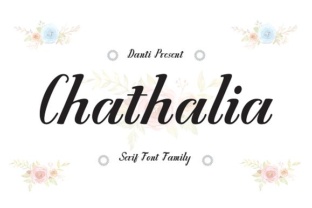
Chathalia is a serif typeface family, but the term serif covers a wide spectrum. Some serif fonts carry heavy slab-like blocks, sharp bracketed transitions, or pronounced calligraphic flourishes. Chathalia takes a different route. Its letterforms are drawn with a smoothness that softens the traditional serif structure. The strokes feel deliberate without becoming rigid, and the terminals curve gently rather than cutting off abruptly. This gives the family a polished, unhurried character that works well in both display and body text settings.
What makes Chathalia worth discussing is its ability to occupy a middle ground. It is formal enough to convey professionalism but not stiff enough to feel institutional. It carries a subtle warmth that can make branding materials feel more approachable, while still maintaining the clarity required for long-form reading. For anyone who has struggled to find a serif that bridges the gap between classic authority and modern readability, Chathalia offers a practical solution.
Smooth Letterforms with Controlled Contrast
The most noticeable trait of Chathalia is its smoothness. Stroke transitions are gentle, and the contrast between thick and thin elements is moderate rather than extreme. This reduces visual fatigue in extended reading and helps the font maintain consistency across different sizes. In titles, the smoothness adds a refined quality without appearing overly delicate. In paragraph text, it keeps the rhythm even, which supports comprehension and retention.
Generous X-Height for Legibility
Chathalia features a relatively generous x-height, meaning the lowercase letters are tall relative to the capitals. This is a practical advantage for body copy because it makes characters more distinguishable at smaller sizes. Readers do not have to strain to differentiate n from h or a from o. For bloggers, publishers, and educators who produce content intended for extended reading sessions, this characteristic directly supports user comfort.
Consistent Weight Distribution Across the Family
A font family is only as useful as its range of weights and styles allows. Chathalia provides a set of weights that progress logically, from a light variant suitable for captions or subtle headings to a bold weight that holds its own in headlines or short display text. The consistency across the family means you can mix weights within the same project without experiencing jarring shifts in color or proportion. This is especially valuable for branding systems where headings, subheadings, body text, and callouts need to feel like they belong together.
Branding and Identity Work
For entrepreneurs, marketers, and freelancers building a visual identity, the typeface often sets the tone before any logo or color palette is applied. Chathalia works well in this role because it does not lean heavily into any one era or style. It avoids the scholarly associations of many old-style serifs and the corporate rigidity of some transitional serifs. Instead, it offers a neutral yet expressive base that can adapt to different brand personalities. A boutique consultancy might use it for a refined, trustworthy impression. A creative studio could use it to signal attention to detail without appearing overly traditional.
When used in logos or wordmarks, Chathalia holds up at various sizes because of its clean junctions and even spacing. The smooth curves prevent the lettering from feeling chopped or uneven when scaled down for business cards or social media avatars.
Paragraph Text and Long-Form Content
Serif typefaces have long been favored for body text in print, and Chathalia extends that strength to digital reading as well. Its moderate stroke contrast reduces glare and shimmer on screens, which can be an issue with high-contrast serifs. The generous x-height and open apertures keep characters distinct, even on lower-resolution displays or in smaller point sizes.
For publishers, bloggers, and educators who produce articles, guides, or course materials, Chathalia provides a reading experience that feels considered without being distracting. Readers can focus on the content rather than the typeface. This is exactly what a body font should do. It is also worth noting that Chathalia includes italic variants that retain readability, which matters when you need to emphasize words or phrases without breaking the flow of the text.
Titles and Headlines
In larger sizes, Chathalia reveals more of its character. The smooth curves become more apparent, and the moderate contrast adds a subtle elegance. It can handle short headlines, section titles, and pull quotes with confidence. However, it is not a display font in the theatrical sense. If you need a typeface that shouts or dominates the page, Chathalia may feel too composed. But for most professional contexts where clarity and tone matter more than spectacle, it performs admirably. Titles set in Chathalia communicate competence and calm authority.
Quality, Usability, and Consistency
From a technical standpoint, Chathalia demonstrates solid craftsmanship. Kerning pairs are well handled, which reduces the need for manual spacing adjustments in design software. The font family includes standard ligatures, numerals, punctuation, and accented characters, making it suitable for multilingual projects. This level of completeness is important for designers and publishers who work across languages or need to localize content.
Usability extends to file performance as well. The font loads reliably in both web and desktop environments, and the character set covers the essentials without unnecessary bloat. For web developers and content managers, this means faster page loads and fewer compatibility issues across browsers.
The consistency of the family is one of its strongest assets. When you use Chathalia across a website, a PDF report, and a set of social media graphics, the visual identity remains coherent. This is not always the case with font families that have uneven weight distribution or stylistic inconsistencies between roman and italic forms. Chathalia avoids those pitfalls.
Who Benefits Most from Chathalia
Chathalia is not a niche font. Its design makes it useful for a broad audience, but certain groups will find it especially well suited to their needs.
- Small business owners and entrepreneurs who need a professional typeface for their brand but do not have the budget for a custom font. Chathalia provides a complete family that can handle multiple roles within a brand system.
- Freelancers and creators who produce content across different media. Whether you are designing a portfolio site, writing a newsletter, or creating presentation slides, Chathalia maintains a consistent voice.
- Marketers and publishers who produce long-form content or editorial pieces. The readability and smoothness of Chathalia support sustained reading, which benefits audience retention and engagement.
- Educators and instructional designers who develop learning materials. Clarity and reduced visual fatigue are important in educational contexts, and Chathalia delivers on both fronts.
That said, Chathalia may not be the best fit for every situation. If your project requires a highly decorative or historically specific serif, Chathalia will feel too restrained. Likewise, if you need a sans-serif for ultra-modern or minimalist applications, this is a serif family and should be evaluated as such. It is also worth noting that while Chathalia performs well in body text, extremely dense layouts with very small point sizes may still benefit from a font designed specifically for microcopy, though Chathalia holds its own better than many serif alternatives.
Practical Recommendations for Using Chathalia
To get the most out of Chathalia, consider pairing it with a neutral sans-serif for digital interfaces where you need clear hierarchy. For example, use Chathalia for headings and body copy, and a clean sans-serif for navigation labels, buttons, and data displays. This combination leverages the warmth of Chathalia while maintaining functional clarity in interactive elements.
In print, Chathalia works well for brochures, reports, and menus where readability and a touch of sophistication are required. Avoid using extremely thin weights in small sizes on uncoated paper, as the fine strokes may lose definition. The regular and medium weights are the most versatile for body text, while bold and semibold handle display roles effectively.
For web use, ensure that you test Chathalia at various breakpoints. Its generous x-height helps maintain legibility on mobile screens, but check that line spacing and font size settings complement the typeface. A line height of roughly 1.5 to 1.6 tends to work well for paragraph text in Chathalia.
Final Thoughts on Long-Term Value
The true measure of a typeface is not how it looks in a promotional specimen but how it performs over months and years of daily use. Chathalia holds up well under that kind of scrutiny. Its smooth, consistent design reduces the need for constant typographic adjustments. Its readability supports content that people actually want to read. And its balanced personality makes it appropriate for a wide range of projects, from brand identities to editorial layouts.
For professionals who value reliability over novelty, and for creators who need a typeface that works as hard as they do, Chathalia is a solid investment. It does not promise to reinvent typography, but it does promise to deliver a polished, practical experience across the contexts where serif typefaces excel. That combination of functionality and understated quality is precisely what makes Chathalia a font worth considering for your next project.