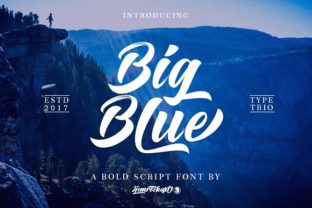
The Quiet Versatility of Big Blue: A Hand-Brushed Font Family for Real Work
Typography choices often feel clinical. You pick a serif for authority, a sans-serif for clarity, and a script when you want something human. But most script fonts behave predictably — too polished, too uniform, too much like handwriting that never actually existed. That is where Big Blue breaks the mold. Designed as a delicately hand-brushed font, Big Blue does not pretend to be typed. It carries the subtle pressure shifts, the uneven ink pools, and the natural drag of a brush across paper. And it does so across three distinct versions that each serve a different purpose in a designer's toolkit.
Why Big Blue Script Feels Like Authentic Handwriting
The first version, Big Blue Script, is what most people envision when they hear "hand-brushed font." It is clean, elegant, and deliberately irregular in all the right places. The strokes taper naturally. The connecting letters do not feel mechanically welded together. Instead, they flow with the kind of rhythm you would expect from someone comfortable with a brush pen rather than a stylus. This is the version you reach for when you need warmth without chaos — a wedding invitation, a boutique logo, or a headline that needs to whisper elegance rather than shout presence.
What sets Big Blue Script apart from other script fonts is its restraint. The ascenders and descenders are balanced. The swashes do not overwhelm the letterforms. Every character feels intentional, as though the designer asked, "Does this loop serve the word, or does it serve the ego?" The result is a script that reads clearly at display sizes but retains its personality when scaled down for subheadings or short body text. For educators preparing certificates, researchers designing presentation titles, or business owners branding a local service, Big Blue Script offers credibility without coldness.
Real-world uses where Big Blue Script excels
- Branded stationery and letterhead where tone matters
- Social media quote cards that need to feel handwritten, not typed
- Product packaging for artisanal goods like coffee, soap, or stationery
- Display headings on personal websites and portfolios
- Short-form editorial pull quotes in digital magazines
The common thread across these applications is that the content benefits from a human touch. Big Blue Script provides that touch without looking like a generic cursive font from the early 2000s. It is modern enough for a tech startup's landing page, yet traditional enough for a law firm's thank-you card. That balance is rare in script typography.
Big Blue Bold Brings Strength to Script
Script fonts typically struggle with weight. Make them too thin and they disappear. Make them too thick and they become illegible blobs. Big Blue Bold solves this by retaining the original hand-brushed structure while increasing stroke thickness in a way that respects the brush's natural behavior. The letters expand outward proportionally. The counters remain open. The overall impression is one of confident presence rather than aggressive bulk.
This version is not merely a heavier version of Big Blue Script. It is a reinterpretation. The brush strokes feel more deliberate. The pressure points are more pronounced. When you use Big Blue Bold, you are telling the reader that this word matters. It works exceptionally well for primary headlines, hero sections, and call-to-action labels where you need urgency without turning off the viewer. A hobbyist building a personal brand could use Big Blue Bold for their name on a business card. A marketing professional might deploy it for a campaign tagline that needs to cut through visual noise.
Considerations when using Big Blue Bold
Because Big Blue Bold carries more visual weight, it demands breathing room. Pair it with generous letter spacing in all-caps settings. Avoid stacking it too tightly against other bold elements. The font performs best when it is the single dominant voice on a page or screen. If you pair it with Big Blue Script, use Bold for the primary message and Script for supporting details. This creates a natural hierarchy that guides the reader's eye without confusion.
For creators working on video thumbnails or social ads, Big Blue Bold holds up well at small sizes because the thick strokes resist pixel blurring. It retains legibility even on mobile screens where fine details often get lost. This practical advantage makes it a strong choice for digital-first projects where the audience is scrolling quickly and needs to capture meaning in under two seconds.
The Unpolished Character of Big Blue Rough
Not every project needs clean lines. Sometimes you want texture, grit, and the feeling that the letters were drawn on reclaimed wood with a worn brush. Big Blue Rough delivers exactly that. It takes the same hand-brushed foundation as Big Blue Script and adds a layer of simulated imperfections — ink spatters, pressure gaps, uneven edges, and subtle grain. The result is a script font that feels aged, tactile, and grounded.
This is the version for projects that benefit from authenticity of a different kind. Where Big Blue Script says "carefully handwritten," Big Blue Rough says "made by hand in a real workspace." It is ideal for brands that emphasize craftsmanship, heritage, or raw materials. A brewery label, a woodworking shop's signage, or a podcast cover about analog creativity would all benefit from the rough texture. Researchers presenting ethnographic studies might use it to imply fieldwork and real-world contact. Educators running workshops could deploy it on materials that signal hands-on learning rather than digital abstraction.
How Big Blue Rough behaves in different media
The rough texture is most effective at medium to large display sizes. At very small sizes, the imperfections can blur together and reduce legibility. If you need the rough aesthetic for body text or small captions, consider using Big Blue Rough at 18 points or larger with adequate tracking. On screens, the font gains an organic feel that contrasts nicely with clean UI elements. In print, it mimics letterpress or screen-printed lettering, especially on uncoated paper stocks that absorb ink unevenly.
One common mistake is applying Big Blue Rough to every element on a page. The roughness loses its impact when overused. Reserve it for headlines, pull quotes, or featured words. Let cleaner typefaces handle the body content. This contrast between rough and smooth creates visual interest and reinforces the handcrafted message.
Choosing the Right Big Blue Version for Your Workflow
Professionals and hobbyists alike benefit from understanding when each version fits best. The decision often depends on three factors: medium, audience, and emotional goal.
- Medium — Digital screens favor Big Blue Script and Big Blue Bold for clarity. Print projects can handle the texture of Big Blue Rough without legibility loss.
- Audience — Corporate clients or conservative industries respond better to Big Blue Script's clean elegance. Creative agencies, artisan brands, and community-focused organizations appreciate Big Blue Rough's character.
- Emotional goal — Trust and sophistication call for Big Blue Script. Urgency and strength call for Big Blue Bold. Authenticity and nostalgia call for Big Blue Rough.
These guidelines are not rigid rules. Some of the most effective uses come from breaking them intentionally. A financial planner's website might use Big Blue Rough for a single testimonial pull quote to humanize an otherwise sterile industry. A children's book author might use Big Blue Bold for chapter titles to create approachable energy. The key is understanding what each version communicates and using that knowledge deliberately.
Pairing Big Blue with Other Typefaces
Big Blue works best when it is the accent voice in a typographic system. Pair it with neutral, highly legible fonts that do not compete for attention. A clean sans-serif like Open Sans, Lato, or Inter provides a stable foundation. The contrast between a geometric sans-serif and the organic brush strokes of Big Blue creates visual rhythm without confusion.
For serif pairings, choose typefaces with moderate contrast and straightforward details. A Garamond or Crimson Text can work, but avoid overly decorative serifs that clash with Big Blue's hand-brushed character. The goal is harmony, not competition. Let Big Blue be the personality and let the companion font be the voice of clarity.
Practical pairing examples
- Big Blue Script heading + Inter body text = elegant blog or article design
- Big Blue Bold call-to-action + Lato navigation = confident landing page
- Big Blue Rough pull quote + Open Sans prose = editorial contrast in long-form content
- Big Blue Script logo + Roboto product descriptions = brand identity with versatility
These combinations work because they respect the hierarchy. Big Blue draws the eye; the companion font supports reading. When both fonts try to lead, the page feels chaotic. When one leads and one follows, the reader moves smoothly through content.
Performance and Technical Considerations
Because Big Blue is a hand-brushed font, each version includes carefully crafted OpenType features. Ligatures ensure that connecting letters flow naturally. Alternate characters allow you to avoid repetition in longer text. If you are using Big Blue in a web project, ensure that your CSS includes font-feature-settings to activate these alternates. Without them, the font may default to standard character sets that do not fully represent the hand-brushed quality.
File sizes for hand-brushed fonts can be larger than standard typefaces because each letter contains more vector points. For web use, subset the font to include only the characters you need. For print use, embed the full character set to guarantee access to alternates and ligatures. Business owners commissioning a logo should request the font files alongside the final asset to retain editing flexibility.
Accessibility is another practical consideration. Script fonts, even well-made ones like Big Blue, should not be used for long-form body text. Readers with dyslexia or visual processing differences benefit from consistent, simple letterforms. Reserve Big Blue for headings, short phrases, and brand elements. Let a accessible sans-serif handle the paragraphs. This approach satisfies both aesthetic goals and inclusive design principles.
Why Creators Keep Coming Back to Big Blue
There are hundreds of script fonts available, many of them free or inexpensive. What makes Big Blue different is its versatility across three distinct versions that share a common DNA. A designer can use Big Blue Script for a client's elegant website, Big Blue Bold for their own portfolio hero, and Big Blue Rough for a personal passion project — all while maintaining a consistent visual language. This saves time and reduces the cognitive load of hunting for new fonts with every project.
Educators appreciate the font's readability at display sizes for classroom materials. Researchers use it for presentations that need visual warmth without sacrificing professionalism. Hobbyists find that Big Blue elevates their projects from obviously templated to intentionally crafted. And business owners discover that a hand-brushed font, used sparingly, communicates care and attention to detail that stock typography cannot match.
The real value of Big Blue lies not in any single version but in the system they create together. You can build an entire brand identity around these three fonts, switching between them depending on context and medium. That kind of flexibility is rare in specialty typefaces. Most hand-brushed fonts offer one mood. Big Blue offers three — and they all feel like they belong to the same hand.