Sketsa Leo: Assessing a Handcrafted Modern Calligraphy Script
When a project calls for personality, warmth, and an immediate human connection, the choice of typeface becomes a defining decision. Sketsa Leo enters this conversation as a modern calligraphy script font created by hand, offering designers and businesses a specific aesthetic tool. This article provides a grounded evaluation of Sketsa Leo, comparing it with other typographic approaches to help you decide if it fits your specific project requirements.
What Defines Sketsa Leo?
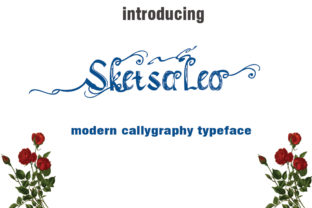
At its core, Sketsa Leo is distinguished by its handcrafted origin. Unlike fonts built purely through mathematical construction, this script carries the organic nuances of manual drawing. The letters flow with a natural rhythm, featuring subtle variations in stroke width and connecting slants that mimic genuine handwriting while maintaining the consistency expected of a professional typeface. This places it firmly in the "modern script" category—a style that balances the elegance of traditional calligraphy with the relaxed, approachable feel of contemporary design.
The primary visual promise of Sketsa Leo is authenticity. In a design landscape saturated with geometric precision, a handcrafted script provides a counterbalance. It introduces a sense of spontaneity and warmth that can be difficult to achieve with more rigid, mechanically structured type families. The nuanced stroke contrast common to pointed pen scripts—thin hairlines flowing into thick, expressive downstrokes—gives the typeface a distinctive rhythm that sets it apart from monotone hand-lettering styles.
How Sketsa Leo Compares with Other Typographic Styles
Selecting a typeface is rarely about objective quality; it is about fit. Understanding where Sketsa Leo sits relative to other common typographic categories clarifies its best applications and inherent tradeoffs.
Against Traditional Formal Scripts
Formal scripts like those based on Copperplate or Spencerian calligraphy are built on strict rules of stroke order, angle, and spacing. They project formality, legacy, and high refinement. Sketsa Leo takes a different path. It relaxes these constraints, replacing rigid elegance with approachable fluidity. The tradeoff here is between authority and accessibility. If your project needs to communicate deep tradition, trust, and precision—such as for heritage branding or luxury invitations—a formal script might be the more appropriate choice. If the goal is to feel personal, modern, and inviting, Sketsa Leo offers a distinct advantage. It acknowledges calligraphy's heritage without being bound by its strictest conventions, making it more accessible to a contemporary audience. The handcrafted irregularities in Sketsa Leo are features, not flaws, adding a layer of human warmth that a perfectly regimented formal script can sometimes lack.
Against Clean Sans-Serif Typefaces
A clean geometric sans-serif is the workhorse of modern design, prized for its supreme legibility, neutrality, and versatility across weights and sizes. Sketsa Leo is its stylistic and functional opposite. Where a sans-serif recedes to let the content speak clearly, a script like Sketsa Leo actively contributes to the visual message. The decision between the two hinges on the project's text hierarchy. For lengthy body copy, complex user interfaces, or multilingual reports, a sans-serif is functionally superior and ensures reading comfort. For a headline, logo, or a single compelling phrase, Sketsa Leo can capture attention in a way a neutral font cannot. The practical limitation is clear: Sketsa Leo is not designed for prolonged reading. It asks to be looked at rather than read through, which makes it a specialist tool for dominant visual roles.
Against Other Hand-Lettered Display Fonts
The hand-lettered font market is diverse, ranging from messy, gritty textures to highly stylized brush strokes with aggressive contrast. Sketsa Leo occupies a practical middle ground. It is clean enough to retain strong readability but textured enough to feel genuinely organic and crafted. Compared to an aggressively stylized brush script, Sketsa Leo feels softer, more fluid, and slightly more formal. Compared to a tidy, monotone hand-lettered sans, it provides more dynamic rhythm and visual interest. This positioning makes it a versatile option for designers who want a handcrafted look without sacrificing clarity or legibility. A key differentiator is the specific calligraphy structure—the emphatic stroke contrast and the flow of connecting strokes often require more considered spacing and sizing compared to simpler hand-lettered styles. This is a tradeoff where aesthetic depth is traded for immediate technological simplicity.
Strengths and Best-Fit Scenarios
Sketsa Leo functions best as a display typeface. It is at its most effective when given room to be seen, where the intricacies of its letterforms can be fully appreciated. Specific scenarios where it tends to excel include:
- Branding for Lifestyle Businesses: It suits brands in the creative, beauty, food, and boutique service industries that want to convey craftsmanship, elegance, and a personal touch efficiently.
- Product Packaging: On labels for small-batch goods, artisan products, or specialty items, the script can communicate the care and attention that went into the product itself, reinforcing a premium feel.
- Short-Form Marketing: Social media graphics, greeting cards, and promotional quote cards benefit from the font's immediate emotional resonance and distinct visual character.
- Logos and Wordmarks: A carefully implemented script can form a memorable identity, particularly when the brand name is concise. The unique connections between letters create a distinct silhouette that is easily recognized.
In these contexts, the strengths of Sketsa Leo are maximized. The handcrafted feel builds trust and distinguishes the content from mass-produced, template-driven design. For a small brand or startup, using a script like this can function as a complete visual identity, reducing the need for complex illustration.
Understanding the Tradeoffs and Limitations
No single typeface is a universal solution, and Sketsa Leo has practical limitations that must be weighed honestly against project needs.
- Legibility at Small Sizes: Like most script fonts, the fine details and stroke contrast in Sketsa Leo can become muddled below 14 points or at small print sizes. It is not suited for body paragraphs, footnotes, or small captions where critical information must be read quickly.
- Formal and Corporate Contexts: The relaxed, modern feel works against it in formal settings that require strict professionalism, such as legal documents, annual reports, or academic presentations.
- Extended Text: Reading a highly expressive script for more than a sentence or two is visually taxing. The brain processes connected scripts differently than print-style fonts, which slows reading speed and reduces comprehension over longer passages.
- Technical Scope: Depending on the specific implementation, Sketsa Leo may have a limited character set compared to a large type family. It may not support all the diacritics or special characters a multilingual project requires, and it likely lacks the variable weight options found in a full type system.
- Pre-Built Connections: Being a script, the letter connections are designed by the foundry. This makes the designer's job easier at large display sizes, but offers less flexibility for tight spacing adjustments compared to a typeface designed for text use.
Recognizing these limitations allows you to deploy the font effectively in its optimal context, rather than forcing it into a role where its weaknesses become apparent.
Key Considerations for Your Decision
Your choice to implement Sketsa Leo should be guided by project specifics rather than general trends. Practical considerations can help clarify the fit:
- Tone and Voice: Does your project need to feel personal, approachable, and artisanal? Or does it require authority, neutrality, and strict formality? Sketsa Leo strongly favors the former.
- Text Volume: Is your content mostly headlines and short phrases, or does it contain long paragraphs? The font is optimized for the former. If you need to convey a long message, consider a supporting sans-serif or serif for the body text.
- Audience Expectations: Will your audience respond to a handcrafted, boutique aesthetic? This is highly effective in lifestyle, creative, food, and wellness niches, but may feel mismatched in more utilitarian sectors.
- Testing at Target Size: Before committing, practical testing is essential. Render a few headlines at your intended final size. Look at how the leading strokes interact. A font that looks stunning in a specimen at 72 points can look uneven or heavy at 24 points if the spacing is not carefully evaluated in context.
Ultimately, comparing Sketsa Leo to other options is not about declaring a winner, but about aligning the tool with the task. If your project calls for a human touch, visual warmth, and a clear hierarchy where the script dominates the visual field, Sketsa Leo represents a well-crafted option in the modern script space. If your priorities are maximum legibility across a complex text block, strict formality, or technical versatility across many weights, exploring other font categories would be the more practical path.
The value of Sketsa Leo lies in its specific character. It is a specialist tool for a specific job. Used correctly, it elevates the design by adding a layer of crafted authenticity that is difficult to achieve with purely mechanical type. The most effective design decisions come from a clear understanding of these tradeoffs, ensuring the final choice serves the content and the audience first.