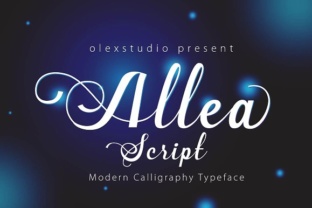
New Allea: A Handwritten Script Font for Modern Branding and Creative Projects
When you work with type daily, you quickly learn that not every script font performs equally well across different media. Some are too ornate for body copy; others lack the character needed for a logo or headline. New Allea sits in a sweet spot. It is a beautiful handwritten script that reads clearly at multiple sizes, works on digital and print surfaces, and brings a natural, approachable feel to marketing materials, craft projects, and brand identities alike. Its fluid strokes mimic genuine handwriting without sacrificing legibility—an uncommon balance that makes it genuinely useful in real workflows.
In this article, we walk through what New Allea is, where it fits into a practical design and content workflow, and how you can integrate it into your own projects—whether you are a small business owner finalizing a label, an educator building course handouts, or a freelancer refining a client presentation.
What New Allea Is (and What It Is Not)
New Allea is a handwritten script typeface designed with smooth, flowing connections between characters. It avoids the stiffness of many formal scripts and the casual illegibility of some brush fonts. The letterforms are constructed so that each word reads as a cohesive unit—an essential trait when the font will appear in short bursts like taglines, product names, or invitations.
This is not a display-only novelty font. While it shines in headlines and small blocks of text (for example, a paragraph on a business card or a short quote on a social media graphic), it remains readable when set at body copy sizes—around 14 to 18 points. That versatility means you can use it across a brand’s visual system without constantly switching type families.
Professionals in marketing, branding, and publishing will recognize the value in that consistency. When your font works in a hero banner, a packaging label, and a bulleted list on a website, you reduce friction in your workflow. You also maintain a cohesive look that builds recognition over time.
Where New Allea Fits in a Creative Workflow
Understanding where a font belongs in your process matters more than simply liking its appearance. New Allea supports several key stages of a project: preparation, execution, and refinement.
Before the Project: Planning Your Typography Palette
During the planning phase, you define your brand’s voice and visual tone. New Allea is a strong candidate for the primary display typeface if you want a warm, personal, yet professional feel. For a bakery or lifestyle blog, it may become the headline font. For a law office or accounting firm, you might reserve it for accent words instead of headings—handwritten scripts can still fit into formal brands as long as the application is intentional.
To plan effectively, test New Allea alongside your body typefaces early. Pair it with a clean sans-serif (such as Open Sans or Lato) for digital content, or a classic serif (like Merriweather) for printed collateral. Check how it loads in a browser, how it renders at small sizes on mobile, and whether it provides enough contrast with the body text to create clear hierarchy.
During the Project: Implementation Across Media
Once you move into production, New Allea integrates into the tools you already use. It works in Adobe Creative Cloud applications (Photoshop, Illustrator, InDesign), web design platforms (Webflow, Figma, WordPress), and office software (Microsoft Word, Google Docs, Canva). Because it is a standard OTF/TTF font, you can install it on both Mac and Windows systems without compatibility issues.
For a typical marketing workflow, you might:
- Create brand guidelines – specify New Allea for headings, subheadings, or pull quotes, with exact point sizes, tracking, and line height values.
- Design social media assets – use the font for quote cards, announcement graphics, and profile banners. Its hand-drawn feel works well with photo overlays and minimal backgrounds.
- Develop packaging – apply New Allea to product labels, hang tags, or box text. Because it retains legibility at smaller sizes, you can include product descriptions without sacrificing readability.
- Format editorial content – use it for chapter titles, section intros, or bylines in a magazine or newsletter. Keep body copy in a simpler font to avoid fatigue.
A crucial implementation detail: when using New Allea in longer passages (more than two lines), adjust the leading (line spacing) to at least 1.4 times the font size. Handwritten scripts need breathing room between lines to prevent the connecting strokes from colliding.
After the Project: Quality Control and Long-Term Consistency
After you launch a design or publish a document, review how New Allea performs in context. Check for kerning issues—some scripts have tight spaces between certain letter pairs like “ff” or “ll.” If you notice gaps, manually kern them in your design software or adjust letter-spacing globally. Also verify that the font renders correctly on older operating systems or in PDFs shared with clients.
For long-term use, keep the font file organized in a shared asset library (like a brand drive or a cloud folder). Include a style sheet or CSS snippet for web use so that team members consistently apply the correct font-weight and fallback stacks. A typical web implementation might look like this:
font-family: 'New Allea', cursive, 'Apple Chancery', 'Comic Sans MS', 'Segoe Script', serif;
This ensures that if the primary font fails to load, users see a similar handwritten style rather than a jarring generic sans-serif.
Practical Workflow Examples for Different Roles
How you integrate New Allea depends on your specific role and project type. Below are three common scenarios.
Scenario 1: Small Business Owner Building a Brand
You run an online stationery shop and need a cohesive look across your website, product listings, and packaging. Install New Allea and use it for your shop logo, product names, and “add to cart” button text. For product descriptions, pair it with a simple sans-serif like Raleway. In Canva, create a template for social media posts that uses New Allea in the headline area and a lighter sans-serif for the body. This repeatable template saves you time on every new product launch.
Scenario 2: Freelance Graphic Designer Working with Clients
A client asks for a “warm but professional” branding package. Present New Allea as an option during the exploration phase. Show it at three sizes: large (for a logo lockup), medium (for a brochure heading), and small (for a business card address). Let the client see that it remains legible across applications. Once approved, embed the font into your client’s brand guide PDF and include a license note—most script fonts require a commercial license, so clarify usage rights upfront.
Scenario 3: Educator Creating Course Materials
You design handouts, presentations, and online course thumbnails. Use New Allea for module titles, key quote slides, and certificate templates. The handwritten style adds a personal touch that connects with students. For the main body of your slides, stick with a clean sans-serif for readability on projection screens. This combination improves visual hierarchy and keeps learners focused on content rather than decoration.
Observations on Compatibility and Optimization
New Allea performs best when you control the environment. In print, test a small batch of labels or flyers before committing to a full run. Handwritten scripts can reproduce inconsistently on uncoated paper or with low ink coverage—choose a smooth paper stock and verify the weight delivers enough contrast against the background.
In digital contexts, pay attention to load times if you embed the font via @font-face. Use font subsetting to include only the characters you need (typically Latin, numbers, and punctuation). This keeps the file size under 100 KB and improves page speed. For email newsletters, avoid using the font at all—most email clients do not support custom scripts reliably. Stick to web-safe fallbacks there.
Long-Term Use and Maintaining Consistency
Once you adopt New Allea into your regular workflow, document its usage rules. Create a one-page style sheet that specifies:
- Minimum and maximum point sizes (e.g., 14 pt for body, 48 pt for headlines)
- Appropriate applications (e.g., headings only, not full paragraphs)
- Acceptable background colors (light neutrals work best; avoid busy patterns)
- Pairing fonts (list the exact sans-serif or serif that accompanies New Allea)
Share this document with anyone who touches your brand—team members, printers, web developers. When everyone applies the same rules, your materials remain consistent even as the team scales.
If you ever need to switch to a different handwritten script in the future, you already have a documented framework that makes the transition smooth. You simply replace the font file and test the new one against the same style sheet guidelines.
Final Practical Tips
Keep these few points in mind when working with New Allea:
- Scale for context. A 24 pt headline on a poster reads well, but the same size in an email might feel too large. Always preview at the final display size.
- Limit usage. Using New Allea for everything dilutes its impact. Reserve it for elements that need emphasis—headlines, names, short calls to action.
- Test with your audience. If you are unsure about legibility, show a mockup to a non-designer friend. Ask them to read aloud the text set in New Allea at your intended size. If they hesitate, increase the size or reduce the density of the text block.
- Respect licensing. Purchase a commercial license if you use New Allea in client work, products, or anything with revenue. It supports the designer and avoids legal issues down the line.
New Allea is not a font that demands attention—it earns it through practical, everyday use. When integrated thoughtfully into your workflow, it becomes a reliable tool for building brands, creating marketing assets, and crafting projects that feel human. Start small: try it on a single project type, document what works, and then expand its role as you gain confidence. That measured approach will help you get the most out of this versatile script without overcomplicating your process.