Cruxially: The Endless Universe of Religious Symbols
Typography has always carried more than words. It carries meaning, history, and belief. Among the many typefaces and symbol sets available today, one stands out for its focus on the sacred and the symbolic. Cruxially is a font that contains nearly 500 glyphs, many of which are crosses, but the collection reaches far beyond that single emblem. It taps into something deeper: the recognition that religious symbols are endless, much like that amazing variety of types of religion itself. For designers, writers, educators, and anyone working with visual communication, this presents both an opportunity and a responsibility.
Religious symbols are among the most potent visual tools in human culture. They condense entire worldviews into a single mark. A crescent moon, a lotus, a Star of David, a wheel of dharma, a cross, an ichthys — each carries centuries of meaning. Cruxially brings hundreds of these symbols together in one place, making it easier than ever to reference, respect, and represent the diversity of faith traditions. But the real value lies not just in quantity. It lies in how these symbols can be used thoughtfully in modern contexts.
What Cruxially Is and Why It Matters
Cruxially is a typeface designed around religious and spiritual iconography. With nearly 500 glyphs, it offers one of the most comprehensive sets of religious symbols available in a single font file. While crosses appear prominently — as the name suggests — the collection also includes symbols from Buddhism, Hinduism, Islam, Judaism, indigenous traditions, and many others. This breadth reflects a simple truth: religious expression is diverse, and visual communication should reflect that diversity.
The relevance of Cruxially goes beyond the niche of religious typography. In a time when audiences are more culturally aware and more sensitive to representation, using the right symbol matters. A mark that is accurate and respectful builds trust. One that is misused or generic can create distance. For marketers, educators, content creators, and business owners, having access to a well-researched set of symbols is not just a convenience; it is a way to communicate with authenticity.
Moreover, Cruxially fits into a broader trend toward intentional design. People are paying more attention to the details of visual language. They notice when a symbol is wrong, out of place, or overly generic. They also notice when care has been taken. A font like Cruxially allows professionals to work with precision, whether they are designing a presentation on world religions, creating content for a multifaith organization, or building a brand that draws on spiritual themes.
The Evolution of Religious Symbolism in Design
Religious symbols have been used in design for as long as design has existed. Early manuscripts, architecture, and art all used sacred marks to convey meaning. In the digital age, however, the use of these symbols has shifted. They appear in logos, websites, apps, educational materials, and social media graphics. With this increased visibility comes a need for accuracy and context.
Historically, many designers relied on a small set of common symbols — the cross, the Star of David, the crescent and star — and treated them as shorthand for entire faiths. But that approach no longer meets the expectations of informed audiences. People today expect nuance. A single symbol cannot represent the full complexity of a tradition, and using only the most familiar symbols can feel reductive. Cruxially addresses this by offering a wider range of glyphs, allowing designers to choose symbols that are specific, appropriate, and meaningful in context.
Another shift is the move toward inclusivity in visual communication. Organizations and creators are increasingly aware that their work will be seen by people of many different backgrounds. Using a diverse set of symbols signals awareness and respect. Cruxially makes this practical by putting hundreds of options at the user’s fingertips, reducing the need to search across multiple sources or rely on limited default sets.
Beyond the Cross: Treasures in the Glyph Set
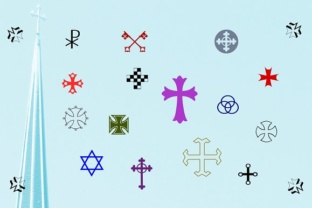
While Cruxially contains many crosses — Latin, Celtic, Greek, Orthodox, and more — the collection is far richer than that single motif. Other glyphs include symbols from Buddhism such as the dharma wheel, the endless knot, and the lotus. From Hinduism, there are Om, the swastika (in its original, sacred form), and various mudras. Islamic symbols include the crescent and star, the Rub el Hizb, and calligraphic elements. Jewish symbols range from the menorah and Star of David to the chai symbol and the hands of the Kohen.
Indigenous traditions are also represented, with symbols like the medicine wheel, the dreamcatcher, and various animal motifs used in spiritual contexts. There are also symbols from ancient traditions, such as the ankh from Egypt, the eye of Horus, the yin-yang from Taoism, and the triquetra from Celtic Christianity. This diversity makes Cruxially useful for anyone who needs to represent multiple traditions accurately, whether in a single project or across many.
What makes these glyphs valuable is not just their variety but their consistency. They are designed to work together typographically, so they can be used in the same document, website, or presentation without visual clash. This is a practical advantage for educators, writers, and designers who need to compare or contrast symbols from different traditions. Instead of piecing together icons from different sources, they can work from a unified set.
Practical Implications for Users and Professionals
For a blogger writing about comparative religion, Cruxially offers a way to include accurate symbols directly in the text. For a marketer creating content for a global audience, it provides symbols that resonate across cultures. For an educator designing a lesson plan on world religions, it supplies the visual elements needed to make material engaging and precise. For a business owner building a brand with spiritual or ethical themes, it offers iconography that communicates values without resorting to clichés.
One practical example: a nonprofit organization focused on interfaith dialogue might use Cruxially to create materials that include symbols from all the traditions they work with. Instead of using generic icons or low-quality images, they can use clean, consistent glyphs that reflect the dignity of each tradition. This small choice reinforces the message of respect and unity.
Another example: a freelance designer working on a logo for a wellness brand that draws inspiration from multiple spiritual paths. With Cruxially, they can explore symbols from Buddhism, Hinduism, and indigenous traditions, combining them in ways that feel authentic rather than appropriative. Having access to a curated set helps them avoid common pitfalls, such as using a symbol incorrectly or out of context.
For creators who produce content about faith, spirituality, or culture, Cruxially reduces friction. Instead of searching multiple font libraries or icon sets, they have a single resource with broad coverage. This saves time and reduces the risk of error. It also encourages exploration — when you have hundreds of symbols available, you are more likely to discover something new and incorporate it thoughtfully.
How Cruxially Fits Modern Workflows
The way people create and share content has changed. Many professionals now work across multiple platforms — websites, social media, print, presentations, and video — and need assets that are consistent everywhere. A font-based approach to symbols is ideal for this. Font glyphs are vector-based, scalable, and work with standard software. They can be used in design tools, word processors, web development, and even in email and documents. Cruxially fits into this workflow naturally because it behaves like any other typeface.
There is also a growing preference for lightweight, self-contained tools. Instead of relying on external icon libraries or image files, a font keeps everything in one place. This is especially useful for web designers who want to minimize load times and avoid dependency on third-party services. Cruxially can be embedded in a website or used as a system font, giving designers control and flexibility.
Another trend is the rise of personal branding and content creation by individuals — freelancers, coaches, writers, and small business owners. These creators often need to produce professional-looking materials without a large budget or a design team. Having a font like Cruxially means they can add thoughtful, high-quality symbols to their work without hiring a designer or purchasing expensive icon sets. It democratizes access to good design, which is a meaningful shift in the creative landscape.
Recommendations for Using Religious Symbols Thoughtfully
Having a large set of symbols is a resource, but using them well requires care. Religious symbols are not neutral marks. They carry deep meaning for the people who hold them sacred. Using them inappropriately — even unintentionally — can cause harm. The following recommendations can help professionals and creators use Cruxially with respect and effectiveness.
- Understand the symbol before you use it. Each glyph in Cruxially has a specific origin and meaning. Before including a symbol in your work, take a moment to learn what it represents and in what contexts it is appropriate. A quick search or consultation with a knowledgeable source is usually enough to avoid missteps.
- Consider the audience. A symbol that works well in one context may be inappropriate in another. For example, the swastika has a sacred meaning in Hinduism, Buddhism, and Jainism, but its use in Western contexts can be misunderstood due to its association with Nazi Germany. Context matters, and awareness is the key to respectful use.
- Avoid overusing a single symbol. Diversity is one of the strengths of Cruxially. Instead of relying on the same few symbols repeatedly, explore the full set. This not only enriches your work but also reflects the variety of religious expression that exists in the world.
- Pair symbols with clear labeling. If you are using symbols in educational or informational content, include text that explains what they represent. This helps avoid ambiguity and ensures that readers understand your intent.
- Stay open to feedback. If someone from a particular tradition points out that a symbol has been used in a way that feels inaccurate or disrespectful, listen and adjust. No one is expected to know everything, but being responsive shows a commitment to learning and respect.
Practical First Steps with Cruxially
If you are new to Cruxially, start by exploring the glyph set. Open the font in a character map or design tool and scroll through the available symbols. Take note of which traditions are represented and which symbols stand out to you. Then, think about the projects you are currently working on. Is there a place where a symbol could add depth or clarity? Perhaps a blog post about spirituality, a presentation on cultural diversity, or a logo for a community organization. Try using one or two symbols in context and see how they change the feel of the work.
For businesses and organizations, consider how Cruxially can support brand consistency across materials. If your brand touches on themes of faith, ethics, or community, having a standard set of symbols ensures that your communication is cohesive. This is especially valuable for nonprofits, educational institutions, and mission-driven companies.
For educators, Cruxially can be a resource for creating handouts, slides, and online content that introduce students to world religions. Instead of relying on generic clip art, you can use accurate symbols that spark curiosity and discussion. When students see a lotus or a dharma wheel rendered clearly, they are more likely to ask questions and engage with the material.
For content creators and bloggers, the font offers a way to add visual interest to articles and posts without relying on stock photography. A well-placed symbol can break up text, reinforce a point, or add a layer of meaning. Used sparingly and thoughtfully, it elevates the reading experience.
Why This Matters Now
The conversation around representation, cultural sensitivity, and visual communication is not going away. If anything, it is becoming more central to how people judge the quality and integrity of content. A font like Cruxially does not solve every challenge, but it provides a tool that makes it easier to communicate with care. It acknowledges that religious symbols are endless, much like that amazing variety of types of religion, and it gives creators a way to honor that diversity in their work.
In a landscape where audiences are increasingly diverse and discerning, small choices matter. The symbol you choose, the way you present it, and the context you place it in all contribute to the message you send. Cruxially offers a foundation. The rest depends on the thoughtfulness of the person using it. With nearly 500 glyphs at hand, there is room to explore, learn, and create work that reflects the richness of human belief.